Common QA Gaps in Government Digital Transformation Programs
 KiwiQA
In this era, technology is evolving frequently. Government sectors are also trying to embrace digital transformation to enhance public service operations. Government sectors are adopting new technologies to drive efficiency, transparency, and engagement. However, it comes with a few complications that must be addressed effectively to ensure swift implementation.
Government digital transformation programs refer to a fundamental approach of reshaping government structures, processes, and services using digital technologies. However, addressing QA Gaps in Government Digital Transformation is essential to ensure these initiatives deliver reliable and user-centric outcomes. These programs include leveraging advancements like AI, cloud computing, big data, and IoT to create efficient, responsive, and citizen-focused services.
Digital transformation in government isn’t just about adopting technologies but about changing the way government works—making it more agile, accountable, and transparent. In the public sector, where budgetary constraints are limited, the need for a well-designed IT strategy that aligns with public objectives becomes critical. Integrating quality assurance testing services into this strategy ensures that systems are reliable, secure, and capable of delivering seamless digital experiences.
According to the study by Deloitte, 96% of respondents said digital revolutions are disrupting the public sector. The digital transformation project should be strategically researched by the skilled QA team. To know a brief about the role of government accessibility testing services in government programs, read the next sections.
Government programs sometimes neglect quality assurance because of conflicting agendas, intricate ecosystems, and reliance on old systems. QA is sometimes viewed as a secondary duty, even though the emphasis is frequently on completing projects within tight deadlines and budgets. This leads to testing gaps, a delay in finding defects, and a decrease in system reliability. In order to overcome these obstacles, the government accessibility testing service must be integrated as an ongoing and essential component of the development lifecycle.
Due to financial limitations, public expectations, and political deadlines, government programs frequently place a high priority on the quick implementation of digital projects. Because of this pressure, QA is no longer viewed as an ongoing process that is incorporated throughout development, but rather as a final-stage activity. Testing is therefore hurried, and serious flaws might not be found until much later. This strategy raises expenses, delays, and rework. Better quality, increased system stability, and more dependable service delivery are guaranteed when the emphasis is shifted towards continuous QA.
A fragmented development environment is often the result of government projects involving numerous vendors, contractors, and technology providers. Inconsistencies in quality assurance could result from varied testing procedures, instruments, and standards used by each vendor.
Coordination is challenging, and the likelihood of integration flaws is raised by the absence of universal testing standards. Government digital systems can be made more collaborative, consistent, and of higher quality by establishing standardized testing frameworks and centralized QA oversight.
Integration with modern applications is difficult and complex since many government systems rely on antiquated legacy technology. These systems frequently have inadequate compatibility and documentation, which makes testing and validation challenging. Furthermore, test environments might not precisely mimic real-world circumstances, which could result in deployment problems that go unnoticed. To overcome these obstacles and guarantee smooth operation and dependability across linked systems, modernization initiatives, enhanced test environments, and strong integration testing techniques are needed.
Initiatives for government digital transformation frequently have serious QA flaws that affect the project’s overall performance. These gaps result from delayed quality assurance procedures, mismatched processes, and a lack of cooperation. Ignoring QA accessibility testing solutions for government early on results in inefficiencies, greater risks, and degraded outcomes. To guarantee scalable, safe, and effective digital solutions in the government sector, these inefficiencies must be addressed.
The QA teams’ delayed participation in the development lifecycle is one of the most common QA gaps. QA specialists lose the chance to spot possible problems early when they are excluded from the requirements analysis stage. As a result, flaws are discovered later, which increases investment & delays. Throughout the development process, early QA interaction guarantees increased system stability, proactive risk mitigation, and better requirement clarity.
The results of government digital transformation projects are greatly impacted by the absence of early QA involvement. Later-stage defects need more time and resources to be fixed, which raises overall expenses. Project timeframes are frequently pushed by delayed testing cycles, which results in delivery delays. Unresolved problems can also lower system performance and stability, which affects user experience. In the end, this results in decreased public confidence and ineffective delivery of dependable and expandable digital government services.
Manual QA testing services for the government slow down development cycles and reduce productivity. Inadequate test automation is a significant problem in government digital initiatives. Regression testing becomes laborious and prone to errors in the absence of strong automation, making it challenging to maintain quality across frequent upgrades. Scalable testing techniques are necessary for large-scale systems.
Government teams must use automated regression testing and incorporate testing into CI/CD pipelines in order to overcome these obstacles. Scalable test automation frameworks guarantee uniform validation across systems, enhanced accuracy, and quicker response. Automation facilitates continuous delivery, improves test coverage, and lessens manual labor. Teams can deliver high-quality digital services at scale, increase productivity, and detect flaws early with this method.
Also Read: Security Testing for SaaS Products: A CTO’s Checklist
In government digital systems, where various platforms and services must cooperate flawlessly, poor integration and end-to-end testing are frequent QA gaps. Inconsistencies in data flow and functioning result from a lack of thorough cross-system testing. Systems may function effectively on their own but malfunction in real-world interactions if they are not properly validated, leading to unreliable services and operational inefficiencies across linked platforms.
Serious risks, such as missing transactions and service interruptions, might result from inadequate integration testing. Errors may occur when users attempt to access essential services, which might cause them to get frustrated and lose confidence. Processes are further complicated by inconsistent data processing across platforms, which eventually leads to citizen discontent and a decline in confidence in digital government initiatives.
During crucial times like elections or tax filing deadlines, government platforms frequently see tremendous traffic. Vulnerabilities in managing such peak loads are caused by insufficient performance and scalability testing. Systems may find it difficult to remain responsive and fast without enough preparation. This disparity emphasizes the necessity of comprehensive testing procedures to guarantee that systems can effectively and consistently manage real-world demand.
Inadequate load testing and a lack of stress and spike testing to replicate real-world usage are two major testing deficiencies. Infrastructure is frequently unprepared for unexpected spikes in traffic, which causes system breakdowns or slowdowns. Organizations run the risk of downtime and subpar service delivery in high-demand situations if performance bottlenecks are not discovered early.
Gaps in compliance testing and accessibility can have a big effect on how inclusive government digital platforms are. Many systems don’t test their usability with a variety of user groups or fully follow WCAG guidelines. This limits equal access to vital public services and undermines the objective of inclusive digital transformation by creating platforms that are challenging for people with disabilities to use.
Citizens with disabilities may not be able to access essential services if accessibility concerns are not addressed. Additionally, it puts organizations at risk for legal repercussions and regulatory issues. Because people want government platforms to be inclusive and easy to use, poor accessibility has a negative impact on public opinion, ultimately undermining credibility and confidence.
Government platforms that handle sensitive citizen data must be secure, yet inadequate security testing continues to be a significant QA flaw. Systems are vulnerable to possible threats due to infrequent vulnerability evaluations and limited penetration testing. Organizations must improve their security-focused QA procedures since inadequate API security testing raises hazards even more.
Inadequate security testing can have serious repercussions, such as data breaches and illegal access to private data. Critical services may be disrupted and national security concerns raised by such a scenario. Above all, they lead to a substantial decline in public confidence, which makes it challenging for governments to keep people believing in their digital systems.
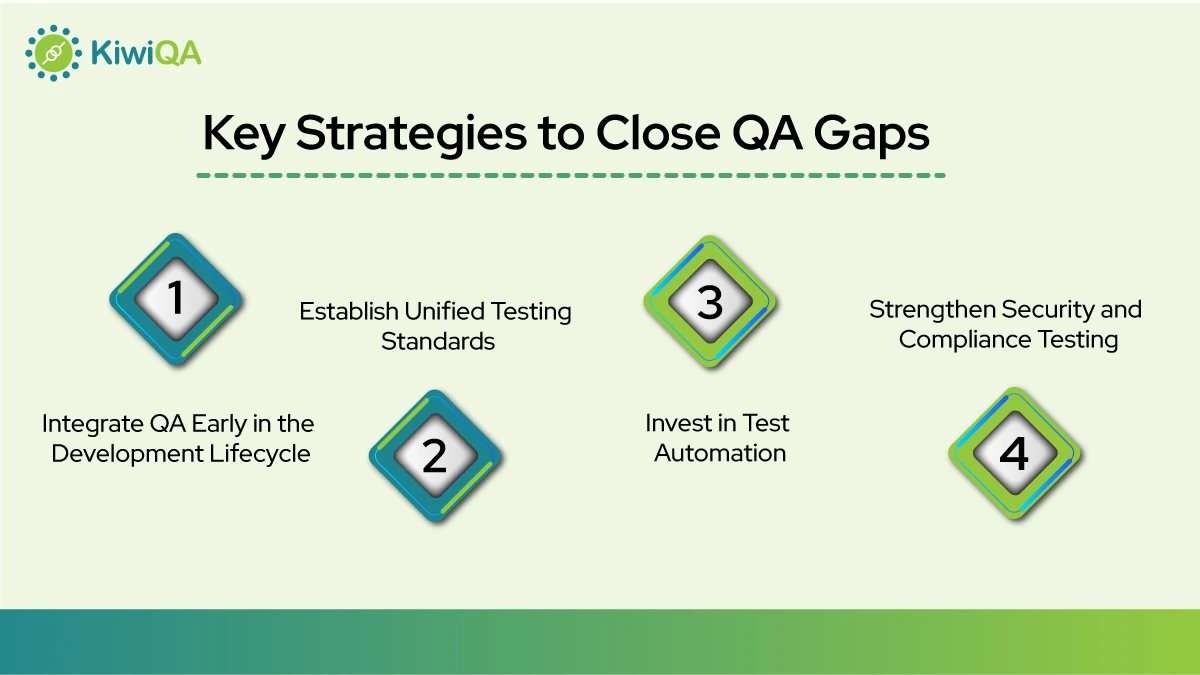
A proactive, methodical approach that integrates quality assurance with each stage of development is necessary to close QA gaps in government digital transformation. Organizations can greatly increase system performance and reliability by utilizing automation, standardizing procedures, and implementing contemporary testing techniques.
Early QA integration guarantees that performance is incorporated earlier into the system instead of the last stage. Potential problems can be found and fixed early on by incorporating QA teams in the requirements analysis and design stages. This minimizes rework, lowers defect leakage, and enhances collaboration between development & QA teams. Additionally, early QA engagement improves the clarity of requirements, which results in improved test coverage, quicker delivery cycles, and more dependable, robust government digital platforms.
Government digital projects can be made more efficient, consistent, and of high quality by establishing uniform testing standards. Teams can adopt a shared strategy thanks to standardized procedures, resources, and documentation, which minimizes misunderstandings and effort duplication.
Additionally, it enhances departmental and vendor collaboration inside the same ecosystem. Organizations may maintain improved quality control, guarantee regulatory compliance, and produce predictable results with well-defined testing processes, ultimately improving the scalability and dependability of digital services.
To increase modern government systems’ speed, accuracy, and scalability, test automation investments are crucial. Automation reduces manual labor and human mistakes by speeding up the execution of repetitive test cases, particularly for regression testing. By giving prompt feedback on code modifications, it facilitates continuous integration and delivery. Organizations may enhance productivity and expedite service delivery by increasing test coverage, detecting faults early, and ensuring consistent performance across big and complex digital ecosystems using the appropriate automation tools and frameworks.
To protect sensitive government data and uphold regulatory standards, security and compliance testing must be strengthened. Frequent penetration tests, secure API validations, and vulnerability assessments aid in locating and reducing possible risks. Penalties and reputational harm are less likely when legal and industry standards are followed. In addition to protecting systems from assaults, a robust security testing framework fosters public confidence by guaranteeing that digital services are dependable, safe, and compliant with regulations.
Also Read: List of Retail Software Testing Services for Scalable Business Growth
Government agencies may measure quality, find gaps, and continuously enhance digital systems by monitoring the appropriate QA indicators. These indicators include information about overall system reliability, defect management, and testing effectiveness. Teams can make data-driven decisions, improve performance, and guarantee consistent delivery of safe, citizen-focused services across extensive government programs by routinely monitoring them.
The number of flaws that escape testing and end up in production is measured by the defect leakage rate. A high leakage rate is a sign of inadequate test coverage and flaws in testing procedures. Teams can find flaws in earlier testing phases and enhance defect detection techniques by keeping an eye on this measure. Maintaining system dependability, minimizing post-release problems, and guaranteeing a flawless user experience for citizens all depend on reducing defect leakage.
Test coverage measures the extent to which functionality, code, or requirements of the application are tested. Increased coverage guarantees that the majority of scenarios, including edge cases, are verified prior to release. It lowers the possibility of hidden flaws and assists teams in identifying untested areas. Particularly in intricate government digital ecosystems, maintaining adequate test coverage boosts trust in system quality, increases reliability, and facilitates better decision-making during releases.
The average time it takes to find flaws after they happen is measured by Mean Time to Detect (MTTD). A lower MTTD denotes effective testing and monitoring procedures, allowing for quicker problem identification. This measure is essential for limiting the impact of mistakes & drive performance. Government teams can guarantee faster feedback loops, lower risks, and sustain reliable and effective digital services by optimizing detection time.
The average time needed to correct found flaws is measured by Mean Time to Resolve (MTTR). It shows how well development and quality assurance teams handle problems. Faster resolution, better teamwork, and more efficient workflows are all indicated by a lower MTTR. By monitoring this measure, teams may improve productivity and guarantee the timely delivery of dependable government apps by identifying bottlenecks in debugging and fixing procedures.
The automated test case, as opposed to a manually tested one, is known as the automation coverage percentage. Increased automated coverage enhances testing scalability, consistency, and speed, particularly for regression testing. It enables teams to find flaws early and conduct numerous tests with little effort. Monitoring this measure guarantees proper testing of big and complicated government systems and supports organizations in evaluating the success of their automation strategy.

QA services for government is a complicated process which needs careful planning, strategic implementation & ongoing evaluation. By addressing the key challenges & approaching the best practices, public sector organizations can manage skill gaps, cybersecurity, and data management. The journey to digital transformation isn’t about the technology but about the commitment to frequent improvement. By embracing the holistic approach & leveraging best practices, the government sector can make valuable changes.
Subscribe to our newsletter for some hand-picked insights and trends! Join our community and be the first to know about what's exciting in software testing.
Welcome to the testing tales that explore the depths of software quality assurance. Find valuable insights, industry trends, and best practices for professionals and enthusiasts.
Discover top SAP S/4HANA testing companies in Australia ensuring ERP performance, seamless integrations, and scalable enterprise success.
Read More
Discover the top 10 Salesforce testing companies in Australia offering end-to-end testing to ensure seamless CRM performance and reliability.
Read More
Explore retail software testing services designed to improve performance, security, and scalability while supporting long-term business growth.
Read More
A practical CTO’s checklist for security testing for SaaS products to identify vulnerabilities, reduce risks, and ensure compliance.
Read More
Fill out and submit the form below, we will get back to you with a plan.
 CRN:
22318-Q15-001
CRN:
22318-Q15-001 CRN:22318-ISN-001
 CRN:22318-IST-001