List of Functional Testing Services for Growing Businesses in Australia
Functional testing has become a necessity in 2026 for attracting and retaining customers. By testing the functionality of your site, you can verify that it matches the user expectations and aligns with organizational goals. Functional testing is the type of testing that seeks to establish whether each app feature works well.
Every function is compared to its respective requirements to validate whether its result is consistent with the end user’s expectations. The functional app testing services are performed by offering sample inputs, capturing actual results, and verifying that it fulfills the expected outcomes.
Mistakes aren’t avoided in manual development; however, sometimes they can lead to costly repairs. When human mistakes cause errors in software, it can put your business in a technical debt, lose consumer trust, and damage your reputation. It potentially leads your project to failure, and that’s why understanding the necessity of software quality is necessary.
Businesses that prioritize software quality standards limit time & waste money. It improves the software lifecycle efficiency. Software quality standards are the widely accepted method to limit uncertainties and improve predictability in the SDLC. According to Capgemini’s World Quality Report, 85% of organizations say quality assurance plays a key role in driving customer satisfaction. Overall, functional app testing services are a basic practice that should be included in the software design and implementation.
This post clarifies the range of functional app testing services, their growing need, and the tools used by experts. We have also described a few points that need to be considered when hiring a functional QA expert.
Software quality plays an important role in the demand for product development. The current competitive IT landscape demands flawless performance & seamless user experience. Since the importance of software quality can’t be ignored, businesses are now prioritizing software quality. The software quality has several effects on business. It takes your organization closer to client satisfaction and functionality. Every business wants to release software that is highly efficient.
Functional testing services are the software quality assurance that validate whether a system matches its individual components and matches specific functional requirements. The QA testers should verify the app’s stability without testing the source code. The basic aim of primary testing is to measure each feature by offering specific inputs and confirming the output aligns with expected outcomes.
With functional testing, businesses can check whether the software performs exactly as expected by the end users. In the testing process, the QA team will focus on ensuring every functionality behaves well. Functional tests are based on various conditions as described in formal specifications like user requirements and models.
Non-functional tests verify that the code is operating correctly, whereas functional tests verify that the code is operating correctly. Methodologies for verifying front-end and back-end components and behaviors are included in both varieties. Functional testing services are frequently slow to perform and costly to write and maintain.
Because unit tests support test-driven development and frequently result in self-documenting code, many developers rely on them the most. When the code needs to be changed, these tests may be easily modified and run quickly. A thorough combination of functional and non-functional testing is the most impartial method for testing decisions. Collaborating functional & non-functional approaches in the CI/CD pipeline can lower expenses for organizations.
Australia’s expanding companies rely more and more on websites, mobile apps, SaaS platforms, and integrated systems to run their businesses and interact with clients. Even little functional problems might cause workflow disruptions, inconsistent data, or lost revenue as digital touchpoints grow.
Every feature, including workflows, payments, integrations, and logins, must function flawlessly across all platforms and browsers, according to the QA functional testing company. Organizations may lower operational risks, support scalability, and preserve system reliability as their digital ecosystem expands by testing fundamental business functionality prior to implementation.
Australian customers demand digital experiences that are quick, simple, and error-free. A single malfunctioning feature, unsuccessful transaction, or unclear procedure can erode consumer confidence in a brand and push them to rival businesses. To ensure that all user journeys execute properly in real-world scenarios, QA functional testing is essential.
Functional testing guarantees consistent performance across platforms for everything from form submissions and checkout procedures to navigation and notifications. Businesses can provide flawless experiences, raise customer satisfaction, and safeguard enduring customer loyalty in cutthroat digital markets by spotting flaws early.
Strict laws like the Privacy Act, data protection standards, and accessibility rules must be followed by Australian enterprises. Legal consequences, reputational harm, and compliance violations might result from functional flaws in data processing, user permissions, or accessibility features.
QA functional testing assists in verifying that apps appropriately implement access restrictions, securely handle personal data, and adhere to accessibility standards. Businesses lower regulatory risk, show due diligence, and make sure their digital platforms satisfy both legal requirements and moral user standards by methodically evaluating compliance-related functionality.
Also Read: Top Software Testing Trends Every Business Must Prepare for in 2026
Validating specific components, features, or modules of an application separately is the main goal of unit testing. Developers at a functional testing company usually carry it out in the early phases of the development lifecycle. Defects like logic flaws, inaccurate computations, or broken situations can be promptly found by evaluating tiny code units separately. The expense of resolving problems later in the process is decreased by early detection.
Additionally, unit testing enhances code quality, facilitates refactoring, and guarantees that every component functions as intended prior to integration. Effective QA functional testing is built on solid unit testing procedures that guarantee stability at the application’s lowest level. Here are some special features-
➥ Test specific features or parts separately.
➥ Finds flaws early in the development process.
➥ Drive the quality & maintenance of code.
➥ Facilitates quicker refactoring and debugging.
➥ Serves as the basis for efficient QA functional testing.
After unit QA functional testing, integration testing confirms that various modules, services, or systems function properly together. Applications developed with APIs, microservices, or third-party integrations are particularly vulnerable. This kind of testing finds problems with data flow, mismatched interfaces, communication breakdowns, and dependency flaws.
Integration testing ensures that integrated parts work together as a cohesive system. Teams can avoid significant failures during system or user acceptance testing by identifying interaction problems early on. For intricately linked digital platforms, it is essential to perform QA functional testing. Read the key points-
➥ Verifies how modules and services interact.
➥ Guarantees proper data transfer between interfaces and APIs.
➥ Early detection of communication and dependency problems.
➥ Crucial for distributed systems and microservices.
➥ Increases the coverage of QA functional testing overall.
System QA functional testing involves testing the product from the initial range to production. It verifies that the system satisfies predetermined functional requirements and that all components function as expected. To guarantee overall system stability, testers assess workflows, corporate procedures, and real-world user scenarios.
Prior to delivery, system testing supports in finding problems with setup, data handling, and end-to-end operation. It guarantees that the application is reliable, consistent, and prepared for user validation as a fundamental stage of QA functional testing. Some key points to consider are-
➥ Confirms adherence to functional requirements.
➥ Mimics user workflows in the real world.
➥ Identifies problems relating to configuration and environment.
➥ Verifies application preparedness prior to UAT.
Smoke testing runs a brief series of fundamental tests to verify that a new build’s essential features are operating as intended. To ascertain whether the program is reliable enough for more testing, it is frequently run following a deployment or build update. Smoke testing prevents deeper testing on unstable builds and saves time by detecting significant failures early.
It facilitates more efficient QA operations and quicker development cycles. In QA functional testing, smoke testing is a crucial checkpoint, particularly in DevOps and agile organizations. Some traits you can assume from this testing service are-
➥ Verifies essential and fundamental features quickly.
➥ Serves as a checkpoint for build validation.
➥ Stops testing on unstable builds, saving time.
➥ Facilitates quicker cycles of development and release.
➥ Frequently utilized in CI/CD and agile settings.
Sanity testing is a targeted, quick testing procedure used to confirm that certain features function properly following small adjustments, bug fixes, or improvements in a new build. Sanity testing, in contrast to extensive regression testing, focuses solely on the application’s impacted sections to ensure that recent modifications haven’t brought about any serious problems. It facilitates QA teams’ rapid assessment of a build’s stability for additional, in-depth testing.
Sanity testing is perfect for agile and continuous delivery contexts because it is usually unscripted and completed quickly. It avoids wasted effort on unstable builds by validating important workflows associated with the modification. Sanity testing, a component of QA functional testing, increases productivity, shortens testing cycles, and guarantees that improvements or fixes behave as intended. Some key features to expect are-
➥ Only pays attention to recent modifications or bug fixes.
➥ Guarantees build stability following small updates.
➥ More focused and quicker than regression testing.
➥ Minimizes needless testing effort.
➥ Increases QA functional testing’s effectiveness.
After updates, improvements, or bug fixes, regression testing involves retesting current features to make sure no unexpected issues are introduced. New code may affect functionality that was previously stable as programs develop. Regression testing supports the early detection of these adverse effects.
To ensure coverage and efficiency, automated regression suites are frequently utilized. Because it preserves application stability, safeguards essential functionality, and allows for frequent releases without sacrificing quality, this kind of testing is essential to QA functional testing. Some key points to expect are-
➥ Retests current functionality following code modifications.
➥ Stops previously corrected flaws from being introduced again.
➥ Safeguards essential business processes.
➥ Frequently automated to increase productivity.
➥ Essential for regular updates and releases.
User Acceptance Testing (UAT) verifies the application from the viewpoint of business stakeholders or end users. It guarantees that the program satisfies workflows, expectations, and real-world needs. Product owners, clients, or end users usually carry out predetermined scenarios in a controlled setting during UAT.
Confirming preparedness for production deployment is supported by feedback obtained during UAT. Before going live, UAT, the last phase of QA functional testing, makes sure the application meets user needs and provides business value. The key traits you can expect through this service are-
➥ Verifies software from the viewpoint of the end user.
➥ Includes actual users and business stakeholders.
➥ Verifies compliance with business needs.
➥ Makes use of real-world situations and procedures.
➥ Stage of final approval prior to production release.

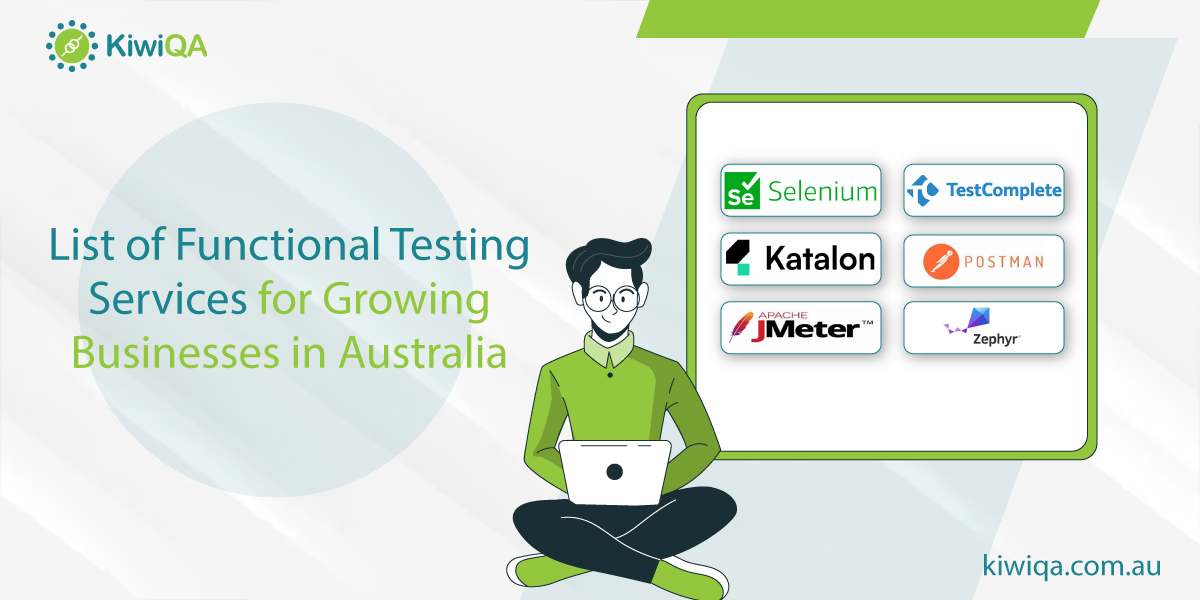
In Australia, Selenium is one of the most popular open-source functional testing tools, particularly for web applications. It is very flexible for a variety of QA teams because it supports several programming languages, including Java, Python, and C#. Testers can automate intricate user processes across several OS & browsers, thanks to the Selenium tool. It is perfect for expanding companies that require scalable QA functional testing while keeping cost-effectiveness and test coverage across modern digital platforms because of its robust community support and simple interaction with CI/CD pipelines.

Australian businesses frequently use TestComplete, an effective commercial functional testing tool, for testing desktop, online, and mobile applications. It is appropriate for teams with different skill levels because it provides record-and-playback capabilities and scriptless testing. Faster test generation and maintenance are made possible by TestComplete’s support for keyword-driven and data-driven testing. It assists companies in guaranteeing consistent application functionality, lowering regression risks, and upholding high standards throughout the QA functional testing lifecycle with its strong object identification and smooth CI/CD integration.

Australian QA teams use Katalon Studio, a renowned all-in-one functional testing tool, for online, mobile, and API testing. Both beginner and expert testers can benefit from its user-friendly interface and strong scripting capabilities. Teams can speed up test automation without requiring a lot of setup thanks to built-in connections with Selenium and Appium. Additionally, Katalon Studio facilitates CI/CD workflows and test reporting, allowing companies to boost overall QA functional testing procedures, reduce release cycles, and increase test efficiency.

For functional testing of back-end services and integrations, Postman is a popular API testing tool in Australia. Without depending on the user interface, it allows QA teams to verify API calls, answers, authentication, and data management. Postman is perfect for agile teams since it supports environment variables, automated test scripts, and collaboration tools. Postman is essential to QA functional testing since it makes APIs operate safely and correctly, especially for microservices, cloud-based platforms, and apps with a lot of integration.

In Australia, online applications, APIs, and back-end systems are frequently tested for functionality and performance using Apache JMeter. JMeter is mostly used for load testing, but it may also be used for functional validation of workflows, data processing, and server responses. It supports the best functional testing services in Australian teams in identifying functional problems under various circumstances and simulating real-world user behavior. JMeter is perfect for businesses wishing to improve QA functional testing while concurrently proving application stability and reliability at scale because it is open source and extremely extensible.

Australian QA best functional testing services in Australia teams frequently utilize Zephyr, a feature-rich test management platform, to plan and monitor functional testing activities. Teams can effectively manage test cases, carry out test cycles, and report errors with Zephyr’s integration with Jira. It offers complete visibility into testing outcomes, coverage, and progress across projects. Zephyr is a crucial part of structured QA functional testing for expanding and enterprise-level organizations because it enhances governance and accountability by fostering better communication between QA, development, and business teams.
The Australian business uses modern testing tools to achieve the following benefits-
When using modern testing tools, it automates repetitive test cases and supports frequent testing within the CI/CD pipeline. It significantly limits the manual effort and drive test execution. Furthermore, it enables the team to release updates faster without hampering quality. Quick feedback cycles support the development team to fix errors early & maintain consistent delivery schedules.
The advanced testing tools we described above allow a comprehensive QA functional testing service provider to test software across multiple platforms. Automation testing minimizes human error and verifies consistent execution of test cases, drives error detection, and broadens the test coverage. It helps to detect edge cases that could be unavailable in traditional testing.
Modern technologies provide real-time visibility into test results by integrating with DevOps and project management platforms. Transparency is ensured throughout the testing lifecycle. It enhances collaboration between QA, development, and business teams. It allows tracking dashboards and reports for the entire team.
Modern testing, automated functional testing services, tools & technologies cut long-term costs by identifying faults early and reducing rework efforts. Additionally, automated regression testing reduces production failures, which helps companies avoid expensive downtime and unhappy customers. Using these tools helps to detect & repair the bugs quickly in less time and cost.
These days, automated functional testing services, tools & technologies are made to evolve alongside the industry trends and user demands. They facilitate rapid adaptation by supporting cloud environments, microservices, and emerging technologies.
Also Read: Key Automation Testing Trends Transforming Australia’s Tech Industry in 2026
Selecting a functional testing partner with expertise in your particular sector is essential for successful results. Domain-aware testers are knowledgeable about typical workflows, user behavior, and regulatory issues specific to industries like financial, healthcare, e-commerce, and education.
This knowledge allows for quicker test creation, more precise test scenarios, and early detection of high-risk locations. A functional testing service provider can match your business goals with QA functional testing methodologies, guaranteeing that essential functionalities are fully validated while cutting down on onboarding time and increasing testing effectiveness.
Advanced automation skills and practical knowledge about modern testing tools like Selenium, Katalon, TestComplete, and API testing frameworks are essential for a successful functional testing partner. Automation-driven QA functional testing speeds up release cycles, lowers regression risks, and increases test coverage.
Seek partners who can include testing in CI/CD pipelines, create scalable automation frameworks, and suggest appropriate solutions based on your technological stack. This guarantees stable quality, long-term efficiency, and maintainability with regular program changes.
Working with a testing partner who is knowledgeable about Australian business practices, regulations, and quality standards has several advantages. Because of local knowledge of data privacy laws, accessibility standards, and compliance expectations, functional testing conforms with national rules.
A functional testing services partner with a local presence or specialized Australian support workers can also provide improved communication, time zone alignment, and faster reaction times. Throughout the testing lifecycle, this localized approach enhances QA functional testing, reduces compliance concerns, and promotes smoother communication.
Examining case studies and customer endorsements helps in confirming a testing partner’s practical skills and dependability. Proven success stories show how the partner has used QA functional testing to produce measurable improvements in performance, quality, or release speed.
Look for proof of maintaining client relationships, managing challenging projects, and producing results that are valuable to the industry. Genuine testimonials with documented outcomes of functional testing service providers boost trust by demonstrating the partner’s capacity to fulfil demands.
The quality standards of software matter a lot in software development. Before you release a product, make sure the software matches compliance, performance, and maintain code standards. Adopting quality approaches to software development helps to save time & money while maintaining app security.
Organizations can keep customers satisfied by taking quality-focused approaches. Quality software supports an organization to stay competitive in the crowded marketplace. Functional testing is a necessary part of DevOps practices, which verifies that the software functions as expected and meets the specific requirements.
As the field of software development frequently evolves, functional testing will continue to play a necessary role in ensuring the delivery of high-quality functional software. Collaborate with the functional testing company to elevate your software game.
Subscribe to our newsletter for some hand-picked insights and trends! Join our community and be the first to know about what's exciting in software testing.
Welcome to the testing tales that explore the depths of software quality assurance. Find valuable insights, industry trends, and best practices for professionals and enthusiasts.

Explore retail software testing services designed to improve performance, security, and scalability while supporting long-term business growth.
Read More
A practical CTO’s checklist for security testing for SaaS products to identify vulnerabilities, reduce risks, and ensure compliance.
Read More
Discover the key automation testing benefits every CTO should prioritise in 2026 to improve software quality, speed up releases, and reduce costs.
Read More
Discover the complete security testing guide for e-commerce websites and mobile apps to prevent cyber threats, secure transactions, and protect user data.
Read More
Fill out and submit the form below, we will get back to you with a plan.
 CRN:
22318-Q15-001
CRN:
22318-Q15-001 CRN:22318-ISN-001
 CRN:22318-IST-001
 KiwiQA