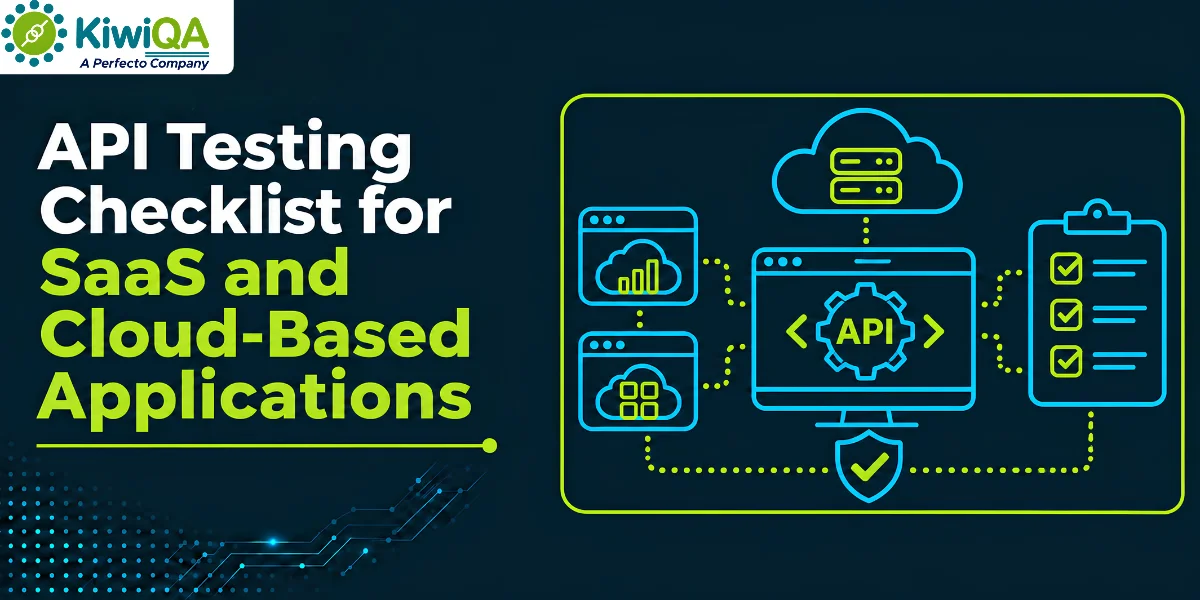
API Testing Checklist for SaaS and Cloud-Based Applications
 Niranjan Limbachiya
API testing plays a crucial role in ensuring the functionality, security, scalability and reliability of SaaS and cloud-based applications. A comprehensive API testing checklist helps QA teams identify integration failures, performance bottlenecks, security vulnerabilities and data inconsistencies before they impact end users.
This guide covers 12 essential API testing practices, including functional testing, authentication, security, performance, multi-tenant isolation and continuous testing. It also highlights API testing best practices, such as prioritising high-risk endpoints, automating repetitive tests and using realistic test environments to improve software quality, accelerate release cycles and minimise production failures.

API testing is used to test the application programming interfaces (APIs) that enable communication between various software systems. QA engineers bypass testing to directly communicate with the backend and examine the answers.
APIs serve as the glue of cloud environments to bring together microservices, databases, mobile apps, and external tools such as payment gateways. Every connection with SaaS platforms should be fast, accurate, and secure, as it connects thousands of users and businesses simultaneously. An experienced API testing company can guarantee that these secret data channels are strong enough to withstand the test of time.
API testing guarantees effective communication between services, microservices and external applications, and safeguards important business and client information from security breaches. It also detects integration failures, slow queries and performance bottlenecks ahead of the users. Moreover, automated API testing helps in quicker and better software releases by checking and validating the code changes at every development stage.
This detailed checklist for API testing covers the entire customer journey and ensures the reliability, security, and performance of your cloud-based architecture.
API functional testing is to ensure endpoints function correctly. Test GET, POST, PUT and DELETE methods, validate parameters and response data, validate accurate HTTP status codes, and test valid, invalid, missing and boundary inputs. In addition, check business logic and accuracy of calculations.
Test API keys, OAuth 2.0 tokens and JWT authentication flows to ensure secure access. Check the permissions, expiration/expired tokens, session timeouts, and token refreshes based on role. Verify that there are administrator-only endpoints to which standard users do not have access.
Having a checklist for API security testing will keep cloud applications safer from common cyber threats. Check for SQL, NoSQL and Command Injection vulnerabilities. Check input sanitization, sensitive data protection, rate limiting, HTTPS enforcement, and TLS encryption. In addition, check endpoints for compliance with the OWASP API Security Top 10 risks.
Benchmark the API response time and latency with normal and peak traffic conditions. Test concurrent requests, detect database bottlenecks and find slow third-party calls, and look for memory leaks or thread locks. In addition, check the timeout settings and recovery actions during system overloads.
Check the smooth flow of data from internal cloud microservices to external apps. Run third party API testing services and CRM, billing and analytics integrations. Verify that data is consistent, dependency management, and responses to unavailability of connected services.
Validate API inbound and outbound data against a JSON or XML schema. Ensure that data types, required fields, null, empty, duplicate and unexpected values are handled appropriately. In addition, test large payloads, special characters and data accuracy in database operations.
Also Read : How Much Does Software Testing Cost in Australia in 2027? A Complete Pricing Guide
Test malicious requests, incorrect query parameters and missing headers to make sure APIs reject invalid inputs. Ensure error messages are useful without revealing the internal stack trace or sensitive information. Provide simulated service downtimes and test fall-back plans and recovery processes.
Check API stability in sudden traffic surges, and high traffic periods. Check cloud autoscaling rule, load balancer distribution and service availability in case of failure of a server or a cloud zone. Also confirm outage recovery, fault tolerance, circuit breakers and retry mechanisms.
Test backwards compatibility to make sure that existing mobile apps and client integrations are compatible with new releases. Simulate API behavior on various browsers and operating systems, as well as under various network conditions. Check for version routing, deprecated endpoint warnings, and version compatibility.
Ensure strict data isolation between cloud databases. Restrict access to test results, so that only access to one’s own organisation’s records are allowed. Additionally, validate tenant specific configurations, webhooks, resource quotas and rate limits. Ensure that tenant IDs cannot be used to access other customers’ information.
Test API deployments in dev, staging and production. Check API gateway routing, caching policies, CORS configuration, environment variables, and cloud secrets management. Test connectivity of serverless functions, containers and databases and proper logging and monitoring.
Set up automated tests to ensure API quality during development and deployment. Track uptime, availability, response times, HTTP errors and failed transactions. Automate contract validation prior to incorporating code changes and regression testing following each cloud deployment.
Also Read : Payment Gateway Testing Checklist for E-commerce Applications
Following proven API testing checklist best practices helps QA teams get maximum test coverage without slowing down release cycles.
Conduct the most rigorous tests on logins, payment methods, and private customer transaction endpoints. A trusted API testing service provider can assist you to identify your largest weaknesses and create targeted API testing company around them if you need any specialized expertise to chart out these crucial workflows.
Manual testing isn’t sufficient to keep up with cloud release cycles. Run your functional, regression and integration tests in your CI/CD pipeline automatically for every code commit.
Clean simple data is used for testing to obscure real-world bugs. Create a production cloud configuration as closely as possible and simulate with realistic payload, different tenant configurations and edge configuration user profiles.
Don’t think about security and speed last. Conducting functional tests alongside your API security testing checklist and load testing helps verify that your new feature performs correctly, securely and scales without issues before it hits production. By implementing these API testing checklist best practices, QA can become a proactive quality gate!
A good API is the foundation of any successful SaaS product, one that is fast, secure and scalable. A checklist for APIs and automated checks that run on a regular, ongoing basis can help uncover bugs that are important at an early stage and avoid expensive outages in production. Working with an expert API testing service provider or an API testing service provider provides you with specialized tools and frameworks, and expert engineers who not only accelerate release cycles but also help ensure that your users are protected. Review your existing QA workflow using this API testing checklist to identify gaps. Then, partner with an experienced API testing company to build an automation roadmap covering essential testing practices and API security requirements.

Subscribe to our newsletter for some hand-picked insights and trends! Join our community and be the first to know about what's exciting in software testing.
Welcome to the testing tales that explore the depths of software quality assurance. Find valuable insights, industry trends, and best practices for professionals and enthusiasts.

Explore the top 10 accessibility testing companies in Australia for 2027 to improve WCAG compliance, digital accessibility and user experience.
Read More
As software systems grow more complex, traditional QA struggles to keep pace with rapid updates. Australian companies are using agentic AI to automate tests, adjust UI changes and fix broken scripts. Working with trustworthy AI testing services can boost efficiency in testing and enhance software quality. Gartner reports that 17% of enterprises have deployed AI agents, […]
Read More
Discover software testing cost in Australia in 2027, including key pricing factors, different testing types, and practical budgeting tips for businesses.
Read More
Explore the 10 best LLM testing tools to evaluate AI model performance, accuracy, reliability, security, and improve large language model testing.
Read More
Fill out and submit the form below, we will get back to you with a plan.
 CRN:
22318-Q15-001
 CRN:22318-ISN-001
 CRN:22318-IST-001
 ISOQAR-UKAS


