10 Best LLM Testing Tools to Evaluate AI Model Performance

 Niranjan Limbachiya
Large Language Models (LLMs) are transforming AI applications, but ensuring their accuracy, security, and reliability requires advanced testing approaches. This blog explains the importance of LLM testing, key evaluation factors, and why traditional testing methods are not enough for dynamic AI-generated responses. Pasted markdown
The article covers the 10 best LLM testing tools that help organisations evaluate AI performance, detect issues like hallucinations and security risks, improve RAG systems, and maintain continuous AI quality. It also highlights how automated testing and monitoring will shape the future of reliable AI development. Pasted markdown
Large Language Models (LLMs) are transforming business approaches to software development and automation. However, as with any AI technology, the risk of erroneous results, security issues, and inappropriate behaviors must be mitigated through careful testing. A 2026 report found that 78% of organisations experienced challenges related to AI-generated outputs, highlighting the need for robust LLM testing and evaluation practices. Thus, LLM testing is crucial for developing reliable GenAI applications.
Engineering teams should implement testing solutions that allow them to thoroughly assess AI performances during the development process. Specialized software testing services offer comprehensive model testing services and advanced tools that ensure quality, security, and overall convenience of AI-driven applications.
Consider the best LLM evaluation tools for testing large language models and learn how to choose the right approach for your organization.
When it comes to evaluating a generative model, traditional binary pass-fail criteria are insufficient. Accuracy is just one aspect of an AI’s competency, which must be further evaluated for its contextual awareness and consistency in order to provide accurate responses to a wide range of prompts in various formats. AI responses may evolve erratically, therefore AI must be continually tested throughout the software development lifecycle.
• Accuracy and relevance of the response: The ability of the AI to provide accurate information that directly answers the query and doesn’t meander off-topic.
• Ability to avoid hallucinations and bias: The ability of an AI to avoid generating unsafe, unethical, or downright false information that could damage the company’s reputation.
• Speed and scalability: The output rate and number of requests handled per second by the AI.
• User experience: The degree to which the results are formatted and presented in a way that is easy to read and helpful.
Conventional software testing practices revolve around deterministic algorithms, in which a certain input invariably generates the same output. This approach is unsuitable for AI due to its chaotic nature and the inability to define a fixed input that would consistently trigger a particular response. The entire point of an AI is to generate outputs that go beyond simple yes/no answers or predefined choices.

Before introducing large language models (LLMs) to the production environment, it is critical to perform various tests with different users and scenarios to expose edge cases. Partnering with enterprise SAP testing services enables organizations to ensure that AI applications comply with data integrity and functional safety across multiple business processes, improving the response accuracy and consistency of AI, and reducing the occurrence of unforeseen outcomes in customer environments.
It is essential to evaluate incorrect outputs, unsubstantiated statements, and factually inaccurate responses during testing. In addition, teams should develop ways to assess answer accuracy, quality, and relevance. Testing RAG (retrieval-augmented generation) processes helps determine whether the right context was retrieved at inference time, ensuring the reliability of results. This can increase the accuracy of responses and help build confidence in the application.
It is critical to monitor the performance of AI models in production to ensure they perform consistently and meet quality standards. In addition, team members should be able to detect distribution shifts resulting from prompt engineering, model fine-tuning, and API version upgrades. QA testing services help optimize workflows and maximize the efficiency of large language models.
Testing tools for LLMs must fulfill critical requirements, including supporting automated testing processes within continuous integration and delivery pipelines. Moreover, the software under evaluation should feature customizable evaluation metrics to measure response quality using rule-based, semantic, or LLM-as-a-judge assessment approaches. Automation testing services can further integrate these checks into regular development workflows.
Modern evaluation platforms offer advanced features that support prompt, RAG, and security testing and enable organizations to compare multiple prompts, measure RAG performance, and identify vulnerabilities such as prompt injections, jailbreaks, and data leaks. Furthermore, human-in-the-loop processes allow judges to score model responses, enhancing evaluation accuracy and consistency.
Organizations should compare their requirements against the capabilities of different LLM evaluation platforms to select the model that fits their needs. Businesses should prioritize tools that offer scalability, extensive functionality, seamless technology integration, and comprehensive reporting to support both technical and managerial audiences. The chosen solution should grow with the company’s needs and provide actionable insights at different levels.

The LangSmith platform is designed by the creators of LangChain to build, test, debug, evaluate and monitor LLM applications. It stores traces of LLM calls, prompts, outputs and their intermediate steps for better debugging and comprehending how the application received a particular output. Teams can create their own datasets to run evaluations, compare model versions and detect regressions. Moreover, the integration with the development allows testing AI applications before launch and after deployment.

DeepEval is an open-sourced library that brings the concepts of unit-testing to the realm of generative AI. The tool offers out-of-the-box metrics to evaluate hallucination, answer relevancy, faithfulness, toxicity and RAG assessments. Developers can design their own tests and utilise it for CI/CD to assess the changes in model behaviour when prompts, models or application code is updated. The tool helps teams that are interested in implementing consistent and repeatable evaluations for their AI applications.

Arize Phoenix is an open-source observability and evaluation platform for AI and LLMs. The tool helps application owners trace their models, analyse retrieval pipelines and embeddings and detect shifts in prompt or model behaviours. The evaluation feature allows investigating the root causes of failures in RAG applications by breaking down the chain-of-thought into retrievals, prompt injections and model outputs. Moreover, the tool helps developers profile their applications to improve the performance and observability of the RAG system over time.

Promptfoo is a lightweight testing framework and CLI for evaluating prompts, models and RAG systems. The tool allows developers to define test cases in a config file and evaluate different prompts or models against the same input. The framework enables application owners to conduct assertions, regression testing and red-team penetration tests for detecting prompt injection vulnerabilities, jailbreaks and other security issues. The tool is helpful for developers and teams that want to set up a sustainable process for testing AI prompts, models and RAG systems without building a complex evaluation framework from scratch.

Ragas, which stands for Retrieval Augmented Generation Assessment, is an open-sourced library that evaluates RAG-based applications. The tool analyses RAG applications to detect issues in the retrieval, augmentation and generation phases through context precision, context recall, faithfulness and answer relevancy. In contrast to other tools, Ragas looks at the context rather than an answer to identify whether the issue is in the retrieval or generation parts of the RAG system. The tool helps knowledge-based applications to assess their performance and utilise the model’s potential better.

TruLens offers LLM application evaluation and observability. It evaluates using the RAG Triad: context relevance, groundedness and answer relevance. These measurements can be used to see if an application is getting the right information, the right information to generate a response, and the right response to answer a question. With TruLens, therefore, it is possible to perform both development testing and continuous monitoring of the quality of AI applications.

Deepchecks provides testing and validation throughout the machine learning and LLM development lifecycle. Teams can use automated checks to evaluate model outputs, detect potential quality problems, and create customised evaluation suites. It provides capabilities in both development and staging environments and can be used in production, ensuring that organisations can continue to operate consistently with AI apps. This is beneficial for businesses that have several AI workflows and deployment environments.

The Open Source Opik platform is a tool from Comet to trace, assess and optimise the performance of LLM and GenAI applications. It offers insights into prompt, model calls, output, latency, and costs, enabling teams to grasp both quality and operational performance. Developers can write metrics to evaluate and analyse application traces and determine problematic interactions. With observability and evaluation this combination helps teams optimise the AI systems while monitoring the resources used.

The MLflow Evaluation module offers a suite of evaluation tools that can be used as part of the larger MLflow machine learning workflow management ecosystem. It facilitates LLM-as-a-judge, built-in metrics, custom-made scorers and generative AI evaluation. Teams can learn about the effect of changes in models and prompts on output quality by comparing them. For organizations that use MLflow for their development and experimentation cycles, it’s possible to integrate LLM evaluation into their workflows.

Humanloop integrates prompt management, assessment, experimentation, and human feedback to enhance AI applications for teams. Developers and product teams can work together to create the prompts, test various versions, and examine the model’s outputs from real interactions with users. Its human feedback features are useful in automated evaluation as reviewers can detect quality problems that the automated metrics might not be able to. Once live, production monitoring and tracing can then be used to further improve applications.
Manual prompt testing can be time-consuming and prone to mistakes. Automated testing frameworks execute hundreds of scenarios rapidly and enable developers to discover defects at an early stage and enhance development effectiveness. These can be complemented with comprehensive software quality assurance services to create robust automated testing pipelines.
User trust can be quickly impacted by safety concerns. LLM evaluation tools can help identify harmful outputs, potential bias, prompt injection risks and other vulnerabilities. Seamless testing ensures consistent responses, minimises AI-related risks, and enhances user safety.
Teams may compare the performance of models on various prompts, contexts and types of queries to determine areas where models are lacking. They can then enhance RAG components, routing logic, and system instructions, using the results of the evaluation. It can also facilitate tracking of performance across different versions of the model and prompt updates, ensuring that teams can gauge improvements and ensure uniformity in AI quality.
As more and more applications are integrated into software products, AI testing will transition out of the development phases. Static evaluation datasets will be replaced with dynamic production checks. Data drift needs to be managed on models that continue to be monitored, and real-time evaluation will be a standard architecture requirement.
Future evaluation platforms will include dynamically test AI applications against edge cases by autonomous agent testers. Intelligent evaluation systems will grow, test workflows will speed up and manual testing efforts will be cut significantly. As these capabilities expand, LLM testing tools will play a larger role in continuous AI quality management.
Enterprise risk standards and regulatory requirements will require increased transparency of AI decision making. Pre-deployment safety checks will be crucial. Transparency will become clearer, and businesses will be put on the spotlight of trustworthy AI that is based on verified compliance standards.

Support for generative AI deployment is critical to having strong metrics, tools, and monitoring. By collaborating with a seasoned software testing company in Australia, organizations can leverage their expertise to seamlessly integrate advanced software evaluation frameworks into their operations.
Incorporate special testing procedures to guarantee the reliability of AI performance, identify problems early, and continually enhance results. Select the tools that are right for you, streamline your testing workflows, and create intelligent, secure AI solutions that create sustainable business value.

Subscribe to our newsletter for some hand-picked insights and trends! Join our community and be the first to know about what's exciting in software testing.
Welcome to the testing tales that explore the depths of software quality assurance. Find valuable insights, industry trends, and best practices for professionals and enthusiasts.

Explore a complete payment gateway testing checklist for e-commerce applications covering security, transactions, integrations, and seamless checkout experiences.
Read More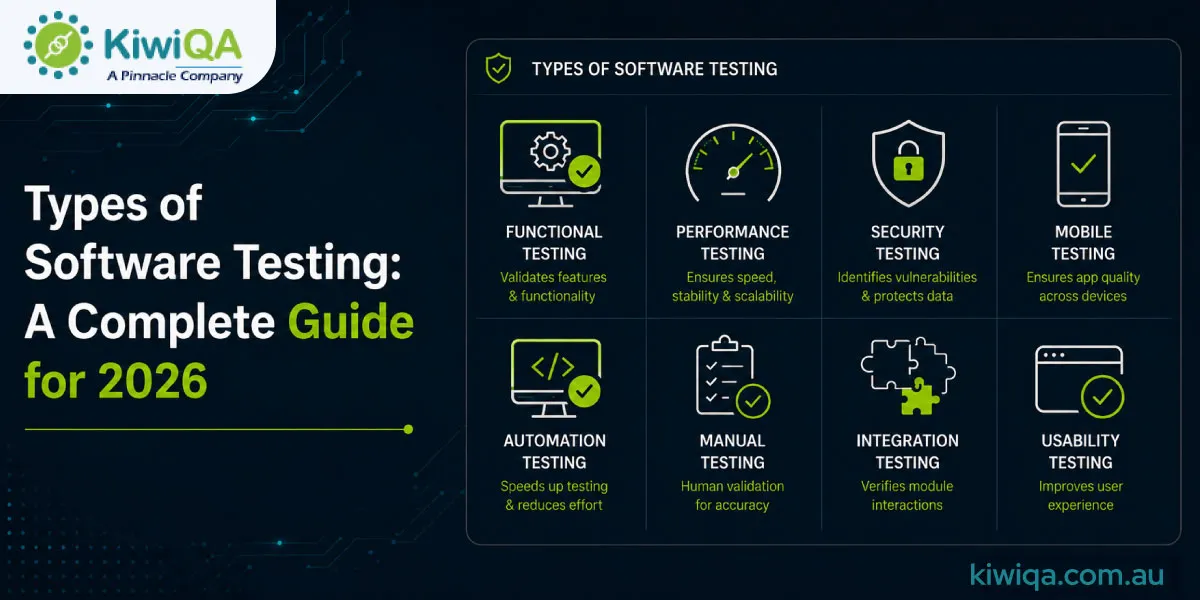
Explore the different types of software testing, including functional, performance, security and automation testing, to build reliable software in 2026.
Read More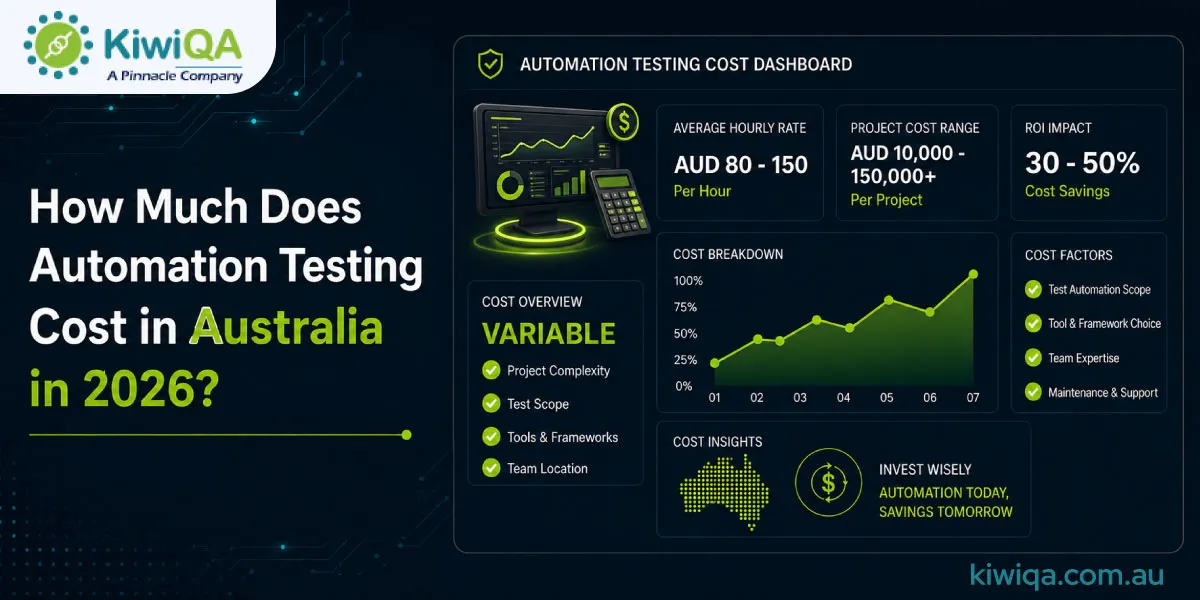
Explore automation testing costs in Australia for 2026, including pricing factors, testing types, tools, and ways to optimise your QA budget efficiently.
Read More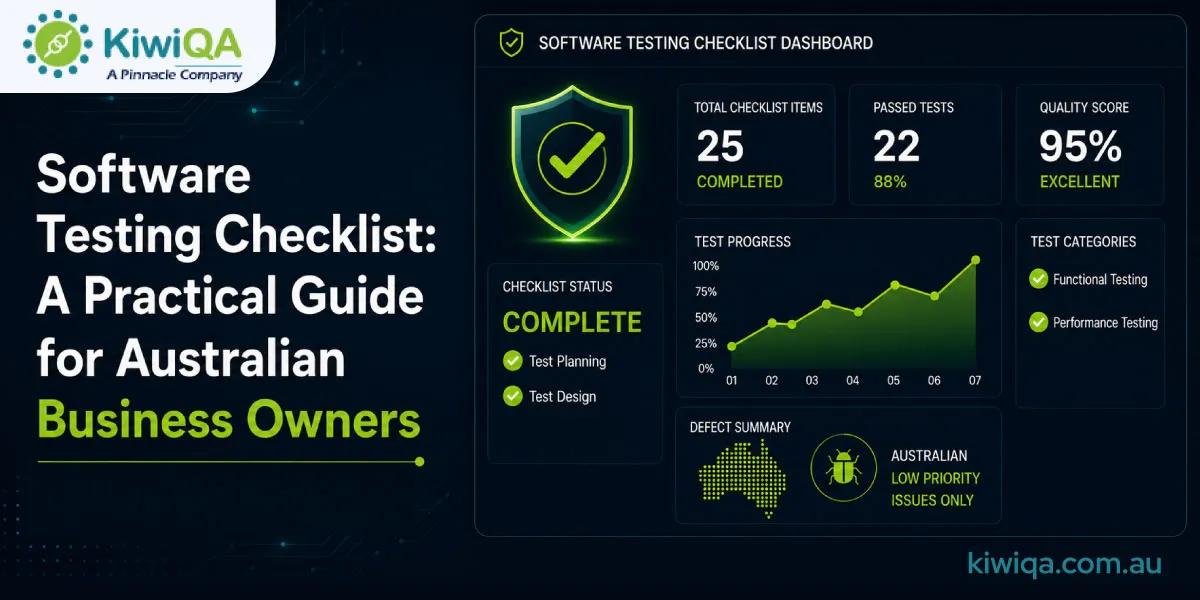
Discover a practical software testing checklist to minimise bugs, improve application performance, and ensure successful software releases.
Read More
Fill out and submit the form below, we will get back to you with a plan.
 CRN:
22318-Q15-001
CRN:
22318-Q15-001 CRN:22318-ISN-001
 CRN:22318-IST-001
 ISOQAR-UKAS


