Types of Software Testing: A Complete Guide for 2026
 KiwiQA
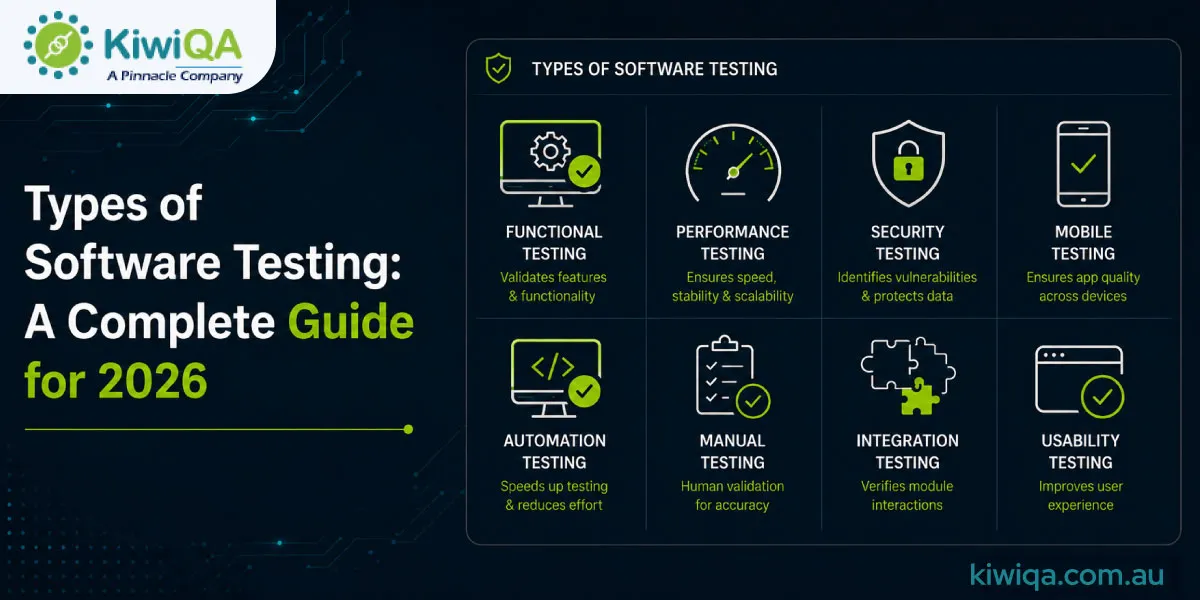
Software testing detects whether an app works accurately, matches requirements, and delivers a reliable user experience. As modern software becomes complicated, testing must include security, functionality, compatibility, usability, and performance. The software testing company allows firms to manage these areas with suitable testing methodologies.
In 2026, testing is becoming more AI-driven and automated. Based on reports, the worldwide software testing market is valued at USD 99.94 billion by 2031. 76% of organizations use AI-driven tools in software testing activities, showcasing the rising popularity of AI in modern QA. Read the following guide to learn about different types of software testing and their goals.
The process of assessing software to find flaws and confirm its expected behavior is known as software testing services. Making sure the application satisfies technical and business requirements is its primary goal. Testing improves software performance, security, dependability, and user experience prior to release by identifying errors before users experience them.

• The role of functional testing is to validate that software features operate accurately. Unit, integration, system, acceptance, and regression testing are all included.
• Performance, security, usability, dependability, and scalability are all assessed through non-functional testing. The software testing services company focuses on the app’s performance in multiple workloads.
• In manual testing, QA specialists perform tests without involving automated tools. Usability checks, exploratory testing, and evolving requirements can all benefit from it.
• Tools are used in automation testing to carry out repetitive test cases automatically. It increases testing efficiency, coverage, speed, and consistency.
• Various phases prior to and following software deployment are covered by the Testing Based on software testing services company Alpha, beta, and production testing are all included.
• The focus of specialized software testing services Australia is on particular platforms, technologies, or application environments. API, database, mobile, web, cloud, SaaS, and AI testing are all included.
Also Read: Software Testing Checklist: A Practical Guide for Australian Business Owners
Unit testing tests specific features, procedures, or components. It is typically performed during development. Testers confirm the functionality of each component by detecting errors early. Errors can be resolved by developers before they impact other areas of the program. Additionally, software testing company Australia improves the quality of the code and lowers the chance that errors arise during later testing phases.
Integration testing is another type of software testing that examines the interoperability of various modules. Testers check interfaces, data flow, and module interactions to ensure accurate information exchange between interconnected components. Applications that rely on databases, third-party services, APIs, or several internal systems can particularly benefit from integration testing. For complex environments involving multiple interfaces and integration points, structured approaches such as KiwiQA’s K-ASSIST framework can help teams improve validation coverage and identify integration issues earlier.
System testing verifies that every part functions as expected. Testers check end-to-end functionality against predetermined specifications. This testing includes system operations, workflows, and key features. It assists in finding flaws that might go unnoticed during component-level testing. Before the application advances to the acceptance stage, system testing verifies that it operates as expected.
Acceptance testing verifies that the program satisfies business needs. It emphasizes anticipated results and business requirements. Testers use predetermined criteria to confirm key features and workflows. Additionally, it increases stakeholders’ trust in the software. Acceptance testing ensures that business expectations are appropriately met and supports deployment decisions.
Software is examined from the viewpoint of the end user through user acceptance testing. It focuses on everyday workflows and actual business scenarios. Users check if the program satisfies their needs. Before deployment, UAT helps in finding errors. Additionally, it verifies that crucial business procedures are operating as expected.
Stakeholders are more confident in the application when UAT is successful. It assists in making sure the program is appropriate for practical use.
Among all types of testing in software testing, Smoke testing verifies the most important features of the application. Testers confirm that fundamental features function as expected. This testing helps in the prompt identification of significant errors. Additionally, it determines if the build is stable enough for in-depth testing. By preventing teams from testing a build with significant initial issues, it saves time.
Sanity testing concentrates on particular features following small software modifications. Testers verify that the latest patches or updates function properly. During testing, this targeted approach saves time. This software type of testing further helps in ensuring that modifications have not resulted in any immediate issues. It is helpful for rapid software updates and frequent development cycles.
Regression testing verifies current features following software modifications. It guarantees that previously functional features are unaffected by new updates, helping teams maintain application stability while supporting continuous releases. A structured methodology such as KiwiQA’s K-RASINS framework can further support functional and regression testing by organizing requirements, scenarios, workflows, and test coverage into a systematic validation process.
Performance testing evaluates the speed, responsiveness, and effectiveness of an application. It measures how quickly the software responds to user input and how the system behaves under different workloads. This testing helps teams identify slow processes, performance gaps, and potential bottlenecks before they affect users. Frameworks such as KiwiQA’s K-SPARC can complement performance testing by providing a structured approach to evaluating performance, availability, scalability, and system behavior under varying workload conditions.
Here, software is tested under anticipated user loads. Testers mimic numerous users using the program simultaneously. They track resource usage, response times, and system stability. This type of testing in software helps in addressing capacity restrictions before they have an impact on users. Additionally, load testing demonstrates whether the program can manage expected traffic volumes without experiencing unexpected performance issues.
In this testing, workloads are increased by testers until the system’s maximum capacity is reached. This helps in determining the breaking point of the application. It also demonstrates the behavior of the system under harsh circumstances.
Scalability testing evaluates an application’s performance as demand rises. This testing helps in identifying restrictions that might hamper future opportunities. It assists companies in figuring out whether their apps can manage growing demand without experiencing significant performance errors.
Testers assess security measures such as access controls, authorization, and authentication. It helps in safeguarding client and company data against possible dangers. Software testing services can help businesses find security flaws and improve application security. By identifying threats beforehand, security testing also promotes safer applications.
Usability testing evaluates an application’s usability. This testing helps in finding errors with the user experience, unclear instructions, and confusing menus. It also indicates potential problem areas for users. Usability testing makes it easier to navigate, streamline interactions, and provide a more seamless experience for various user types.
Compatibility testing determines whether an application functions properly on various devices, operating systems, browsers, and screen sizes. Testers evaluate how an application behaves on various supported platforms and ensure consistency.
Accessibility testing determines whether a disabled person can access it or not. Keyboard navigation, screen readers, color contrast, and other accessibility features are assessed by testers. This testing helps in identifying errors that might keep users from accessing information. Testing for accessibility promotes inclusive online experiences. Additionally, it assists companies in developing applications that are more user-friendly for a larger audience.
Reliability testing evaluates an application’s long-term performance consistency. They search for unexpected breakdowns, disruptions, and stability errors. This testing helps in determining the availability and consistency of software. Additionally, reliability testing demonstrates whether the program can continue to carry out necessary tasks without frequent issues.
In manual testing, the QA team is responsible for performing test cases manually without using automated tools. Here, the QA team fully engages with the product. It is helpful for scenarios where human involvement is required. Additionally, manual testing is effective when requirements are constantly changing. It allows testers to swiftly adjust and look into unexpected application behavior.
Automation testing runs pre-written test cases using specialized tools. Automated tests can be executed repeatedly with consistent outcomes, helping teams reduce manual effort, accelerate testing, and expand test coverage. Large applications with frequent releases particularly benefit from automation because it supports faster and more reliable validation. KiwiQA’s K-FAST framework can strengthen this process through a structured automation approach covering planning, automation design, execution, and reporting, helping teams establish more scalable and maintainable automation practices.
Multiple factors are responsible for determining what to choose between automated and manual testing. The appropriate strategy can be influenced by the project size and challenges involved. Frequency of testing is also important, particularly for applications that are frequently released. Team resources, available funds, and application stability should all be taken into account. Requirements for long-term testing are also crucial. Both approaches are used in many projects to obtain more comprehensive and efficient test coverage.
To find significant flaws, development and testing teams use controlled environments. They examine overall functionality, workflows, and essential features. Alpha testing helps in the early detection of errors. It also offers insightful comments regarding the stability and quality of the software. An application’s readiness for beta testing can be ascertained through successful alpha testing.
Before the final release, a small number of actual users participate in beta testing. Their input helps in discovering errors with functionality, performance, and usability. Additionally, it assists teams in comprehending user expectations and refining the application prior to its public release.
After an application is deployed, production testing is performed. Teams focus on important business processes and application behavior. They verify that key features function properly for actual users. Errors that were missed earlier can be found with the help of production testing. To lower risks, teams can use controlled tests and monitoring tools. Additionally, it allows the prompt identification and fixing of production errors.

Application programming interfaces and their interactions with other systems are examined through API testing. Testers verify integrations, data formats, requests, and responses while supporting the QA team to measure safety, functionality, and quality. Applications that rely on numerous services, third-party platforms, or backend systems should undergo this testing.
Database testing verifies the data management, retrieval, and storage capabilities of an application. Testers verify the consistency and integrity of data across various operations. Additionally, they test database connections, stored procedures, transactions, and queries. These types of software application testing help in finding processing errors and data-related flaws.
Mobile application testing measures apps made for iOS and Android smartphones. Testers examine various devices, operating systems, screen sizes, and configurations. They verify usability, performance, navigation, and key features. This testing helps in finding interface and device-specific issues. Additionally, it ensures that mobile applications offer a uniform experience across compatible devices and OS versions.
Web application testing evaluates the usability, performance, and functionality of browser-based applications. Testers confirm key features and user processes. Additionally, they test responsiveness on various screen sizes. To find compatibility errors, testing is done on a variety of devices and browsers. This contributes to the consistent operation of web applications. Additionally, it allows a seamless experience for users who access the application from various environments.
Applications kept and run in cloud environments are evaluated through cloud testing. Testers examine the availability, scalability, dependability, and performance of applications. They evaluate how the program responds to an increase in workloads or user demand. Cloud testing also helps in finding performance errors. Additionally, it ensures that apps can function efficiently in their cloud environment.
Software delivered via cloud-based subscription models is tested through SaaS testing. Testers examine subscription workflows, integrations, and multi-tenant functionality. Testing makes it possible for various users to utilize the platform without interfering with one another’s access or data. As customer usage rises, SaaS testing helps ensure consistent application performance and dependable service delivery.
Applications using intelligent models and algorithms are evaluated through AI and machine learning testing. Testers verify model consistency & accuracy while evaluating unexpected results and possible bias. Testing for generative AI may involve identifying inconsistent responses. This testing helps guarantee that AI-powered applications deliver expected and beneficial outcomes.
Testers may evaluate software without adhering to strict, predetermined test cases by using exploratory testing. Based on their expertise and experience, testers investigate various features. They watch how applications behave and look into surprising outcomes. When requirements change frequently or when testers need to swiftly explore new application areas, exploratory testing is helpful.
This testing methodology lacks thorough planning and documentation. Testers examine the application and find hidden flaws using their expertise. They might test unexpected user behaviors. This technique can highlight errors that are not covered by planned test cases. Ad hoc testing offers extra quality checks and complements structured testing techniques well.
End-to-end testing measures an application’s entire user journey by validating each stage. It may involve several interconnected databases, systems, services, and applications. This testing helps in verifying that business workflows function properly throughout the process. Additionally, end-to-end testing finds integration errors that could impact users in real-world situations.
Positive testing uses expected and valid inputs to verify applications. Testers provide appropriate data and adhere to standard user scenarios. They check if the system generates the desired outcomes. This testing verifies that features operate as expected under typical circumstances. Positive testing ensures that users can accomplish routine tasks without running into unnecessary errors. It also helps validate core functionality.
Negative testing evaluates how an application responds to unexpected inputs. Testers verify that the proper error messages and responses show up. This testing helps in finding errors and measures the stability of the system in unusual circumstances. Negative testing makes sure that unexpected user actions don’t result in security issues, crashes, or data loss.
Also Read: List of Automation Testing Services That Improve Business Agility
The way testing teams operate is being transformed by AI-powered software testing. AI can help create test cases and find flaws more quickly. Additionally, when application components change, it may help with self-healing test automation. Teams can concentrate on high-risk areas first by using predictive test prioritization. These features can help teams produce reliable software more quickly, cut down on repetitive tasks, and increase testing effectiveness.
During the development phase, testing is incorporated into CI/CD pipelines. As new code is added, tests are conducted on a regular basis. This helps find flaws earlier and gives developers quicker feedback. Frequent software releases are supported by continuous testing without sacrificing quality. Additionally, it shortens the time between testing and development. Throughout the delivery cycle, teams can continuously verify the app functionality, consistency, and performance.
Testing tasks are moved earlier in the SDLC with shift-left testing. Before the application reaches later stages, testers and developers find possible flaws. Early testing can lower the expense and effort needed to resolve errors. Additionally, it promotes greater cooperation between the QA and development teams. It improves app quality by identifying errors before they become challenging to fix.
After an application is deployed, shift-right testing focuses on testing and monitoring it. Teams utilize user feedback and production data to comprehend the behavior of real-world applications. This method assists in addressing usability, performance, and reliability errors that might not come up during pre-release testing. Teams are able to react swiftly to issues through ongoing monitoring. Additionally, it contributes to the improvement of application quality over the course of its operational lifecycle.
The process of developing automated tests is made easier with low-code test automation. Testers can create workflows with reusable parts and visual interfaces. This reduces the requirement for in-depth programming expertise. Teams can increase automation coverage and speed up test automation with low-code tools.
• Determine what the software must accomplish and what users expect.
• Test features that directly impact customers and business operations.
• Consider the application’s architecture, technologies, integrations, and overall complexity.
• Verify that the application complies with applicable industry regulations and test for security threats.
• Verify the application’s capacity to manage expected traffic, workloads, and users.
• Depending on your project’s needs and testing objectives, consider software testing services Australia.
• Select testing strategies that offer sufficient coverage within your time and budget limitations.

Selecting the ideal testing approach from the list of software testing types supports businesses in improving their software security, quality, and performance. It is necessary to start by identifying your app’s requirements, business priorities, and risks. A skilled software testing company helps to develop a practical QA strategy that fits your goals. If you are seeking trusted software testing company Australia solutions, collaborate with experts who have immense knowledge in these fields.

Subscribe to our newsletter for some hand-picked insights and trends! Join our community and be the first to know about what's exciting in software testing.
Welcome to the testing tales that explore the depths of software quality assurance. Find valuable insights, industry trends, and best practices for professionals and enthusiasts.

Explore the 10 best LLM testing tools to evaluate AI model performance, accuracy, reliability, security, and improve large language model testing.
Read More
Explore a complete payment gateway testing checklist for e-commerce applications covering security, transactions, integrations, and seamless checkout experiences.
Read More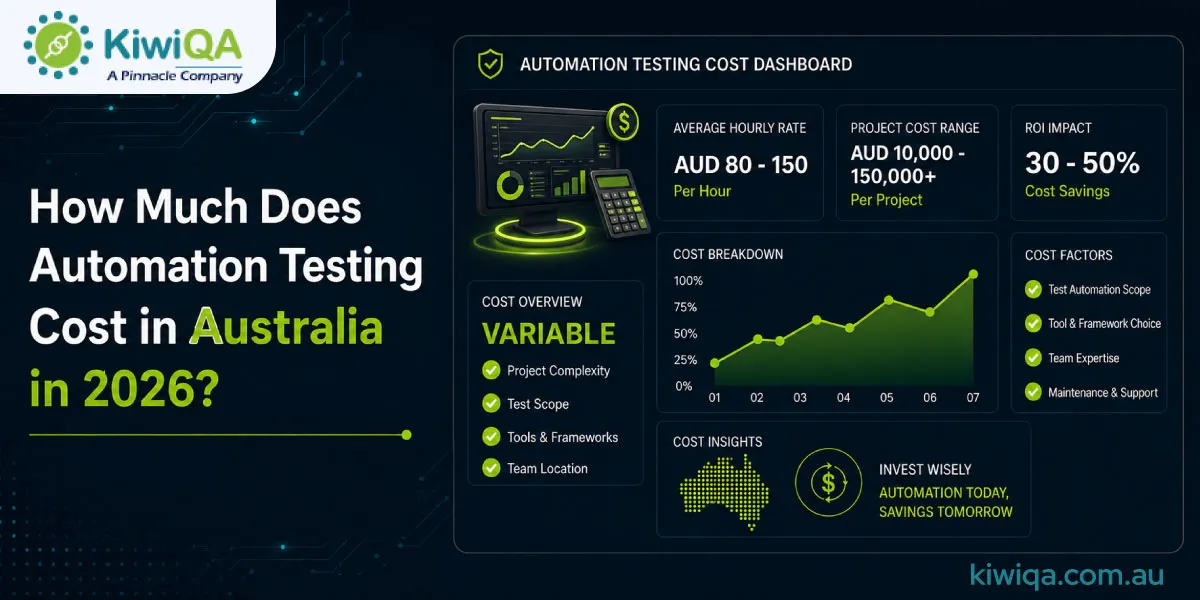
Explore automation testing costs in Australia for 2026, including pricing factors, testing types, tools, and ways to optimise your QA budget efficiently.
Read More
Discover a practical software testing checklist to minimise bugs, improve application performance, and ensure successful software releases.
Read More
Fill out and submit the form below, we will get back to you with a plan.
 CRN:
22318-Q15-001
CRN:
22318-Q15-001 CRN:22318-ISN-001
 CRN:22318-IST-001
 ISOQAR-UKAS


