Software Testing Checklist: A Practical Guide for Australian Business Owners
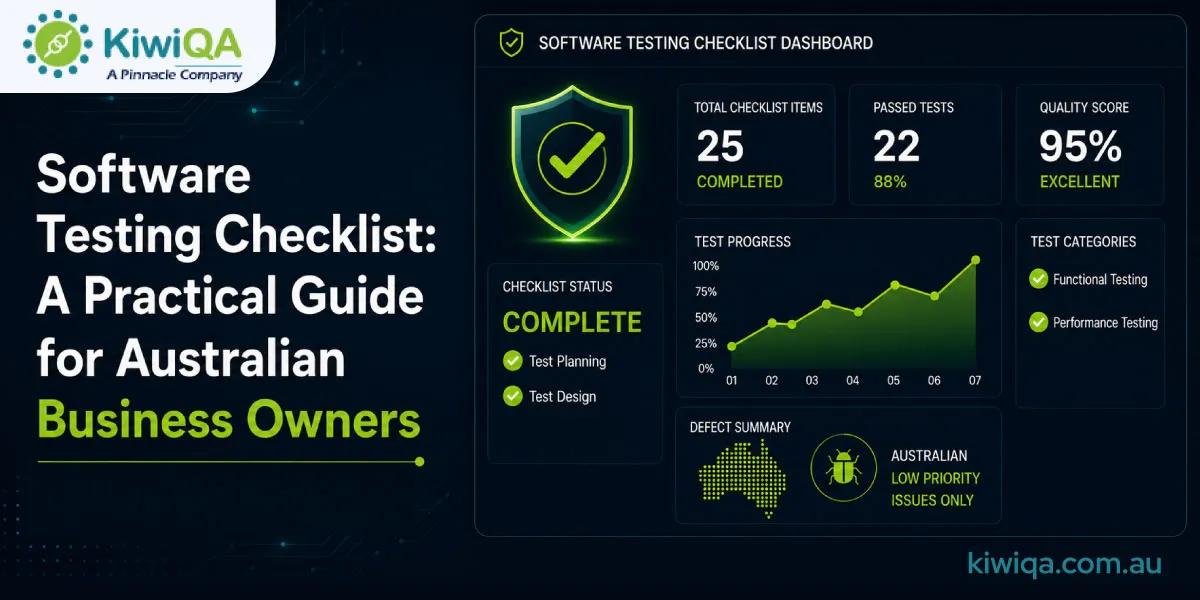
The software testing process can be a little tough. The team of testers gets stressed when they try to coordinate the complex elements. A well-structured software testing checklist helps organise the testing process, ensures no critical test case is overlooked, and improves software quality. Software testing services are a common step in the development process to make sure the software is secure and functional. A thorough software testing process helps identify defects, performance issues, and security gaps before an application goes live.
According to industry studies, fixing a bug after release can cost up to 30 times more than resolving it during the development phase, while over 80% of software defects are identified through structured testing before deployment.
A structured document that lists all the features, tasks, and quality checks that must be finished before software is delivered is called a software testing checklist. The checklist in software testing assists QA teams in consistently verifying functionality, usability, performance, security, compatibility, and general reliability.
By adhering to a checklist, companies lower the possibility of missing crucial problems and uphold testing standards across projects. The software testing company guarantees that every crucial component is fully validated prior to reaching clients.
The software testing checklist can assist business owners in lowering expensive errors, enhancing product quality, and providing a better customer experience. Prior to launch, a checklist guarantees that important company operations, user journeys, and security protocols are examined.
By offering a transparent testing procedure, it also enhances collaboration between the development and QA teams. Businesses may minimize post-release problems, safeguard their brand, cut maintenance costs, and deploy software with more assurance by using a methodical software testing checklist.

Consumers expect consistent, reliable digital experiences. Extensive testing by a software QA testing service avoids bugs, crashes, and performance problems that may damage consumer loyalty.
Software testing services company reduces downtime, security flaws, data loss, and operational disturbances by finding flaws prior to deployment. Businesses can reduce expensive failures while preserving reliable and continuous software performance by identifying problems early.
Applications that have been thoroughly tested provide seamless navigation, quick loading times, safe transactions, and reliable performance. Good user experiences boost customer confidence and strengthen long-lasting client relationships.
Also Read: Top 10 Banking Software & App Testing Companies in Australia (2026 Edition)

Before testing starts, clearly identify the software’s purpose, expected outcomes, and main business objectives. Determine the target market, user requirements, and essential business procedures. Clear requirements assist software testing consulting teams in developing relevant test cases, confirming expected functionality, and guaranteeing the delivery of high-quality software.
Verify that every feature is covered by the testing scope by going over all specified functional requirements. Check dashboards, payment procedures, buttons, forms, user journeys, and integrations. Make sure all requirements are precise, comprehensive, and thoroughly recorded.
Determine which features, processes, and quality standards need to be validated in order to establish precise testing objectives. Establish success criteria, rank testing tasks according to risk and business impact, and coordinate expectations with project stakeholders.
Before being released, a functional software testing service in Australia ensures that each feature operates as intended. To guarantee smooth functioning, a reputable software testing company examines user activities, business logic, processes, and integrations.
Make sure users have no trouble registering and navigating their accounts. Check for incorrect login attempts, OTP authentication, email verification, and password resets. Verify session management, account lockout policies, and secure authentication.
Make sure that all mandatory and optional fields work properly by testing each form. Verify postcodes, phone numbers, email addresses, and other inputs using the proper formats.
Verify that the application’s menus, internal links, CTA buttons, and page redirects all function properly. Ensure users can access pages easily.
The following checklist for software testing promotes accessibility, layout, navigation, and user experience. Businesses may develop intuitive applications that boost customer happiness and promote engagement.
Examine the overall layout to make sure everything is organized. Make sure the content is aligned, the fonts are readable, the colors are consistent, and the spacing is correct. Users should be able to immediately comprehend the interface without unnecessarily scrolling.
Check to see if users can finish routine tasks on their own. Verify that the navigation, labeling, and instructions are simple to follow. Enhancing the overall experience boosts customer confidence, lowers irritation, and promotes platform engagement and return visits.
Make sure users with varying abilities can access the software. The software testing companies verify keyboard navigation, picture alt text, text accuracy, and sufficient color contrast.
Frequent performance software tester manual testing checklist guarantees constant functionality during high traffic.
Use network settings to measure the page speed on every device. Determine which third-party resources and images are causing performance issues.
To assess system stability, simulate several users accessing the program at once. While preserving reliable performance, load testing assists businesses in preparing for times of high demand.
Analyze how well an application performs across a range of mobile networks, tablets, and smartphones. Test the responsiveness of buttons, scrolling, and loading speed on multiple screen sizes.
Authentication, data security, payment security, and compliance requirements are evaluated by a reputable software testing consultancy. Thorough testing lowers cybersecurity risks, safeguards private data, and increases customer trust in the software’s reliability and security.
Make sure that user data is safely sent, stored, and only accessible to those who are authorized. Test secure session management, encryption, authentication, and password security. Sensitive data protection lowers cybersecurity threats, boosts consumer confidence, and assists companies in adhering to established data protection and privacy regulations.
Check the operation of the payment gateway, transaction processing, and payment confirmation messages. Ensure that unsuccessful transactions are managed safely and without disclosing private data. While offering consumers trustworthy and smooth online payment experiences across supported payment methods, payment security testing guarantees the protection of financial data.
Examine consent management, privacy rules, and consumer data handling practices. When appropriate, make sure software complies with Australian privacy regulations and enables safe information handling. Compliance testing lowers legal risks, safeguards consumer data, and exhibits ethical data management techniques that build credibility and trust over the long run.
Software operates consistently across browsers, devices, operating systems, and screen sizes thanks to compatibility testing. Prior to release, it assists in identifying layout problems, malfunctioning features, or inconsistent behavior.
To ensure consistent functioning and look, test the application on each browser. Verify that interactive elements, buttons, navigation menus, and forms function properly in all supported browsers. Browser compatibility testing guarantees that users get the same reliable experience.
Check that the program works properly on tablets, smartphones, laptops, and desktop computers. Test graphics, navigation, touch interactions, and responsive layouts on various screen sizes. Regardless of the hardware specs or display resolution that clients utilize, device compatibility testing contributes to a smooth user experience.
Test the functionality of apps on iOS, Android, macOS, and Windows. Testing for operating system compatibility enables companies to give consumers solid experiences regardless of the platform or device they use to access the application.
Accurate, interesting, and search engine-friendly content is ensured by content and SEO testing. Verify that the information is up to date by reviewing the metadata, headings, photos, and internal links.
Make sure that service descriptions, prices, contact information, and company facts are up to date and consistent. The target audience should be reflected in the content, and the messaging should be clear.
Check the heading hierarchy, alt text for images, and meta title/descriptions. Make sure pages naturally target relevant keywords and adhere to SEO best practices.
Examine references to Australian locations, contact details, service regions, and, if relevant, Google Business Profile information. Make sure the target regions and corporate presence are appropriately reflected in the local content.
After deployment, post-launch testing verifies that the live application operates as intended. Continuous testing helps in early issue detection, enhances software stability, and preserves a reliable user experience after updates or new launches.
After deployment, test all critical pages, forms, buttons, payment procedures, reservation systems, and email alerts. Verify that each crucial procedure is operating properly in the real world.
Check that Google Analytics and Google Search Console are accurately set up. Reliable analytics offer insightful information about user behavior, marketing effectiveness, and chances for continuous website and application development.
After launch, keep an eye on system logs, performance alerts, and user-reported problems. To preserve software quality, reduce downtime, and guarantee ongoing progress throughout the product lifecycle, schedule routine testing following upgrades or the release of new features.
Also Read: SaaS Testing Company in Australia for End-to-End QA Solutions
It is necessary to assess technical proficiency, industry understanding, communication, and service quality when selecting a partner for software testing services in Australia. A trustworthy provider offers precise testing, clear reporting, quicker releases, and ongoing QA assistance.
Choose the best software testing services partner with successful records in the industry. The ideal team understands user expectations, identifies business-specific risks, meets regulatory requirements, and produces more precise and efficient testing results.
Select a provider that offers usability, functionality, performance, security, compatibility, and automated testing. In-depth testing services guarantee total software quality, lower risks, boost application dependability, and facilitate effective product launches.
Examine how the testing partner shares advice, reports flaws, and updates you on progress. Transparent reporting, frequent updates, responsive teamwork, and clear documentation all help in the speedy resolution of projects.

By concluding all these things, we can say that a software functional testing checklist acts as the core tool to validate high-quality software. By following the straightforward checklist and hiring a software testing services company, businesses can guarantee that their software matches the user requirements and performs well.

Subscribe to our newsletter for some hand-picked insights and trends! Join our community and be the first to know about what's exciting in software testing.
Welcome to the testing tales that explore the depths of software quality assurance. Find valuable insights, industry trends, and best practices for professionals and enthusiasts.

Explore the 10 best LLM testing tools to evaluate AI model performance, accuracy, reliability, security, and improve large language model testing.
Read More
Explore a complete payment gateway testing checklist for e-commerce applications covering security, transactions, integrations, and seamless checkout experiences.
Read More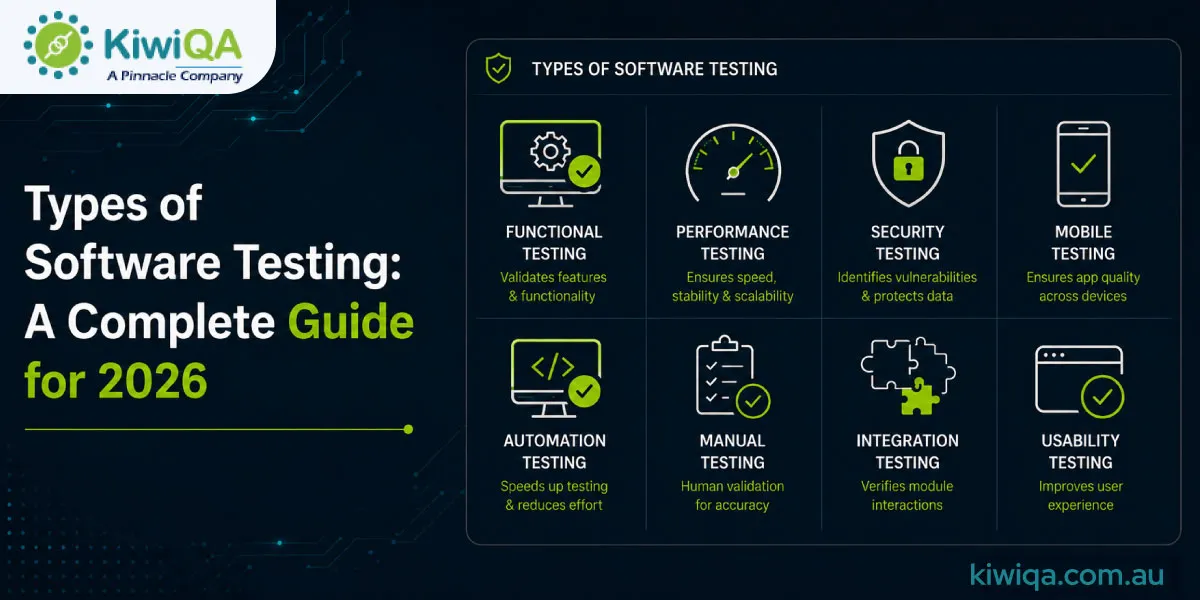
Explore the different types of software testing, including functional, performance, security and automation testing, to build reliable software in 2026.
Read More
Explore automation testing costs in Australia for 2026, including pricing factors, testing types, tools, and ways to optimise your QA budget efficiently.
Read More
Fill out and submit the form below, we will get back to you with a plan.
 CRN:
22318-Q15-001
CRN:
22318-Q15-001 CRN:22318-ISN-001
 CRN:22318-IST-001
 ISOQAR-UKAS
 KiwiQA


