How Much Does Automation Testing Cost in Australia in 2026?
 Niranjan Limbachiya
Automation testing has become a crucial part of software development in Australia. It helps firms improve app quality while reducing the maximum effort involved in repetitive testing. From startups to large enterprises, Australian businesses are widely relying on automated testing for quick digital transformation, frequent delivery, and reliable software performance. As development environments become complicated, organizations are relying on automation testing services to develop scalable frameworks.
The worldwide automation testing landscape is expected to hit $78.94 billion over the next 5 years. However, the success of automation testing depends on the choice of technology and tools. Understanding the potential cost breakdown allows businesses to plan their testing budgets and select suitable automation strategies. It also helps firms to compare various approaches, from building an in-house training team to partnering with a skilled QA provider.
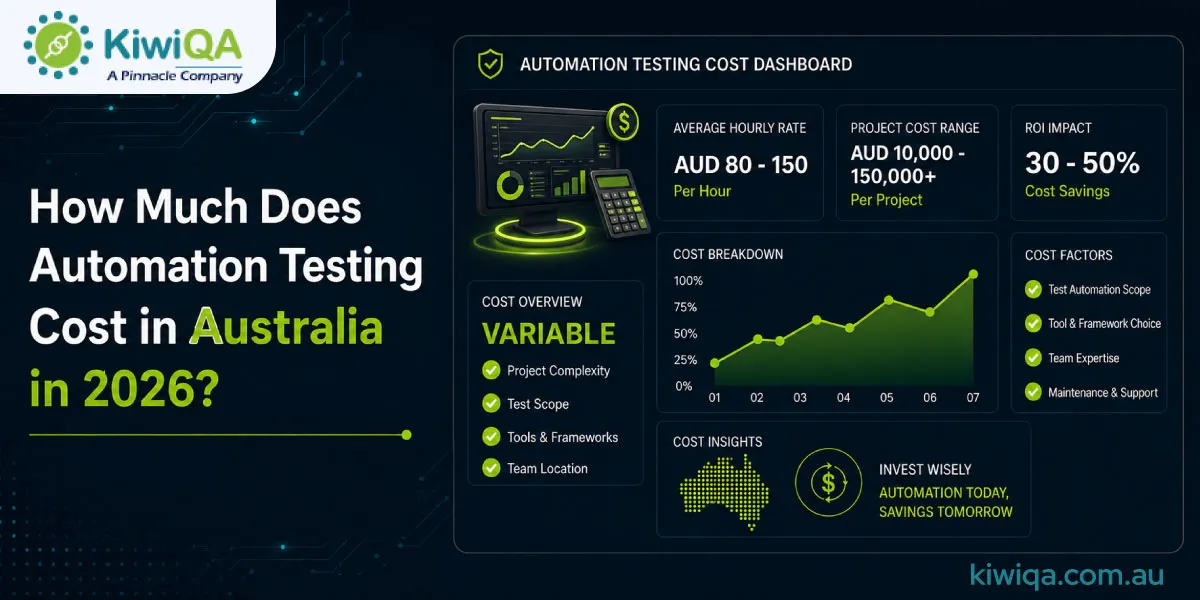
The cost of automation testing in Australia in 2026 can vary significantly based on the scope and complications of the project. Factors like app size, QA requirements, tech stack, automation framework, integration requirements, team skills, and ongoing support impact the costs. Therefore, firms must evaluate both technical & business needs before investing in automation testing.
Automation is a software testing practice that uses tools, scripts, and frameworks to automatically execute predefined test cases and validate app behavior. In manual testing, the QA team performs each step themselves, whereas in automation, faster and more consistent test cases can be executed. Automation testing service is useful for repetitive and time-consuming scenarios. The common use cases of automation testing are regression testing, functional testing, API testing, performance, and cross-browser testing.
Organizations select automation QA to improve software release while managing consistent quality. Automation testing companies improve QA efficiency, allowing teams to focus on high-value activities. It decreases recurring efforts and delivers long-term operational & cost benefits for growing businesses.

A successful automation project is built on test strategy and planning, which also affects the final cost. To comprehend application functionality, risks, and testing goals, the process starts with requirement analysis. After that, skilled automation testing service providers create a thorough test plan that includes priorities, tools, resources, schedules, and testing methodologies. How automation will be implemented and expanded over time is outlined in an automation roadmap. By assessing frequency, complexity, stability, and potential ROI, teams also determine which test cases are appropriate for automation.
Developing the technical framework required to carry out and manage automated tests effectively is known as automation framework development. The first step involves choosing a framework based on testing goals, scalability, technology stack, and application requirements. Teams may set up a custom framework with suitable configurations and architecture for particular business requirements.
To reduce repetitive coding and speed up test development, developers also produce reusable components. Clear test results, execution status, failures, and other insights are provided by the reporting configuration. It further helps teams in evaluating automation performance and identifying problems.
The process of creating reliable automated scripts from identified test scenarios is known as test script development. Writing automation scripts that mimic user actions and validate expected application behavior is the first step taken by automation engineers. Additionally, they concentrate on developing reusable test cases, which enable the execution of common processes and functions in various scenarios without the need for duplicate code.
Automated tests can accurately verify application responses, data, and functionality when validations are handled properly. In order to increase test coverage and decrease manual labor, data-driven testing can also be used to run the same test scenario using various datasets.
Accurate results and consistent execution of automation tests depend on the test environment. Setting up necessary software, databases, servers, tools, and application dependencies is part of environment configuration. To simplify testing across various browsers, OS screen sizes, and mobile devices, teams may also set up browsers and devices.
Preparing test data guarantees that scripts are executed with suitable and controlled datasets. Businesses may choose to use local or cloud infrastructure, based on their needs. The environment that is selected has an impact on setup time, scalability, resource requirements, and total testing expenses.
To find bugs and confirm expected functionality, test execution involves running automated test suites against the program. Teams organize and manage the execution of automated tests across necessary environments, browsers, devices, or application versions. Automation tools help identify defects during execution by highlighting unsuccessful test cases and unexpected outcomes.
To identify the reasons behind failures and differentiate app bugs from environmental or script-related problems, testers analyze test results. Stakeholders can gain valuable insights into test coverage, execution trends, and overall application quality through performance reporting.
Due to the frequent changes in applications, technologies, interfaces, and business requirements, automation scripts need to be maintained constantly. Test scripts are routinely updated by teams whenever application workflows, components, or functionality are changed.
Additionally, they focus on fixing automation errors caused by code modifications and environmental problems. The automated test suite is kept up to date with current functionality by supporting changes to the application. Teams may eventually implement framework enhancements to improve execution speed, scalability, and consistency while reducing unnecessary maintenance.
Businesses can maintain the efficacy and value of their automation investment over time with ongoing support and optimization. Teams can find unstable environments, invalid scripts, unsuccessful tests, and ongoing issues with regular monitoring. The goals of test suite optimization are to remove unnecessary tests, increase execution speed, and give priority to high-value scenarios.
As application functionality and business requirements grow, teams can concentrate on creating new test cases. Automation processes can become more effective and scalable while maintaining consistent software quality through ongoing quality improvements.
Also Read: Test Automation Strategy Guide 2026 for AI-Driven Software Testing

One of the main elements influencing the automation testing price is project complexity. More test cases, automation scripts, environments, and maintenance are usually required for larger applications. The amount of work required to successfully automate testing also depends on the number of features and workflows.
Advanced validation and customized test scenarios may be necessary for complex business logic. Compared to simple applications, those with numerous user roles, dependencies, and interconnected processes usually need more extensive automation, which raises the costs of development, execution, and maintenance.
The automation strategy, tools, and resources required are directly impacted by the kind of application being tested. While mobile applications frequently require testing across various devices, OS, and screen sizes, web applications may need browser and cross-browser testing. Specialized tools for validating endpoints, data, and integrations may be needed for API testing. Scalable environments and testing across various configurations may also be necessary for cloud applications, which could raise the total cost of automation testing.
The number of scenarios that must be automated and maintained depends on the testing scope. Regression testing makes sure that current functionality stays consistent after updates, whereas functional testing concentrates on confirming whether application features operate in accordance with business requirements.
API testing verifies that various software components and services can communicate with one another. More automation scripts, test data, environments, and execution cycles are usually required for a project that covers all of these areas. Therefore, firms can more accurately estimate automation costs by precisely defining the necessary testing scope.
Both the initial and ongoing costs of a project can be significantly affected by the automation framework chosen. Open-source frameworks can provide flexibility and lower licensing costs, but configuration, customization, and maintenance require qualified experts.
Although they frequently come with licensing fees, enterprise testing solutions may offer advanced capabilities, integrations, reporting, and support. Although they take more time and technical expertise to develop, custom frameworks can be created around particular business needs. The ideal framework should strike a balance between budget, scalability, usability, and project requirements.
The tools, programming languages, frameworks, and integrations needed for automation are influenced by the technology stack of the application. Programming language proficiency in Java, Python, JavaScript, or C# may be necessary for QA automation testing service providers.
To make sure automation tools integrate well with the architecture of the application, framework compatibility must also be considered. Databases, external services, authentication systems, and third-party integrations can all make testing more difficult. The total cost of automation testing may increase when an application uses multiple technologies.
Automation testing cost can be significantly impacted by the testing team’s experience and skill level. Automation experts create and maintain reliable testing frameworks and scripts, while QA engineers must comprehend application requirements and create efficient test scenarios.
In order to ensure that automated tests appropriately reflect business processes, projects involving specialized industries may also need domain expertise. Although their hourly or project rates may be higher, experienced professionals can minimize long-term maintenance efforts and implementation errors while improving test quality.
Because automation testing necessitates more configuration and DevOps knowledge, integrating it with CI/CD pipelines can affect automation testing cost. Continuous testing helps teams find errors early by allowing automated test suites to run whenever new code is committed or deployed.
Additionally, automation might need to interface with source-control systems, build tools, automated deployment procedures, and DevOps workflows. CI/CD integration can support faster software releases and significantly decrease manual QA time.
Small companies frequently require a test automation solution that offers potential value without adding unnecessary costs. They are expected to give top priority to crucial processes that have an immediate impact on clients and essential business functions. Businesses can begin with essential automation, concentrating on high-priority and repetitive test cases, instead of automating everything at once.
Scalable testing, which enables the addition of new test cases and applications as the company expands, should be a key component of the testing framework. This strategy enables small businesses to increase quality while maintaining their automation investment cost-effectively.
Mid-sized companies need more extensive automation coverage because their applications and development processes are more complicated. To increase overall test efficiency, they can improve automation coverage across various testing. Automated test integration with development pipelines allows for quicker feedback during software development and enables teams to find errors earlier.
In order to enable automated tests to run consistently with new builds and releases, businesses should also integrate testing with development pipelines through CI/CD workflows. Automation can increase release efficiency and help mid-sized businesses produce reliable software more quickly by avoiding manual testing.
Comprehensive automation strategies that can support numerous teams, technologies, business processes, and large applications are necessary for enterprise businesses. They frequently require enterprise-level automation frameworks that are built for security, scalability, maintainability, and system integration.
Web, mobile, desktop, APIs, browsers, devices, and OS can all be tested across multiple platforms. Businesses should incorporate automated testing throughout the SDLC to implement continuous QA. To organize thousands of test cases, execution results, and reporting, they also need comprehensive test management.
What it covers: UI automation testing verifies application interfaces, such as buttons, forms, navigation, workflows, and user interactions.
Best use cases: It is especially helpful for applications with frequent interface updates, customer-facing workflows, and repetitive functional and regression scenarios.
Factors affecting implementation effort: Application complexity, workflow size, supported browsers and devices, UI stability, test data requirements, and framework compatibility all affect costs.
What it covers: Endpoints, requests, responses, authentication, data processing, status codes, and communication between application components are covered by API automation testing.
Best use cases: Microservices, backend systems, integrations, databases, and applications where API functionality supports several front-end platforms are among the best use cases.
Factors affecting implementation effort: The quantity and complexity of APIs, authentication methods, data dependencies, integrations, test environments, and necessary test scenarios all influence implementation effort.
What it covers: Mobile automation testing verifies user interactions, performance, navigation, and application functionality across mobile devices and operating systems.
Best use cases: It works well for iOS and Android apps that need frequent functional, regression, compatibility, and release testing.
Factors affecting implementation effort: The number of devices, screen sizes, operating system versions, application complexity, device availability, and testing infrastructure all affect costs. Implementation requirements and continuing costs may also be impacted by testing across physical devices and cloud-based devices.
What it covers: After new features, updates, bug fixes, or configuration changes, regression automation confirms that the functionality of the application is still operational.
Best use cases: Applications with frequent releases, sizable codebases, intricate integrations, and ongoing development cycles benefit greatly from it.
Factors affecting implementation effort: The size of the current test suite, the complexity of the application, the frequency of releases, the number of automated scenarios, and the maintenance needs all influence effort.
What it covers: Performance testing assesses an application’s responsiveness, scalability, stability, speed, and behavior under various workloads.
Best use cases: High-traffic websites, enterprise apps, e-commerce platforms, APIs, and traffic spikes are among the best use cases.
Factors affecting implementation effort: Expected workloads, the number of concurrent users, testing environments, performance metrics, infrastructure requirements, and application architecture influence implementation.
What it covers: Cross-browser automation ensures that web applications work consistently across various operating systems, screen configurations, browser versions, and browsers.
Best use cases: It is crucial for web applications and customer-facing websites where users access services via various devices and browsers.
Factors affecting implementation effort: The quantity and versions of browsers, OS, devices, screen resolutions, and test scenarios all affect costs.
What it covers: Complete business workflows, including interactions between the application, databases, APIs, and third-party services, are validated by end-to-end automation.
Best use cases: It works well for crucial processes like order processing, bookings, payments, e-commerce transactions, user registration, and other multi-system journeys.
Factors affecting implementation effort: Workflow complexity, the number of integrated systems, environments, test data requirements, and application architecture all influence effort.
When requirements, workflows, or application components change, automated scripts must be updated on a regular basis. Test reliability is ensured by ongoing maintenance, but it can raise long-term automation costs. The cost of licensing, implementation, integration, scalability, and maintenance can all be impacted by the selection of a test automation solution.
Automation complexity may be increased by integrations with databases, payment gateways, APIs, CRMs, and external services. Additional configurations, environments, test data, and specialized knowledge may be needed to test these dependencies.
Automation complexity may be increased by integrations with databases, payment gateways, APIs, CRMs, and external services. Additional configurations, environments, test data, and specialized knowledge may be required to test these dependencies.
Infrastructure, configuration, browsers, devices, databases, and test data are all necessary for establishing and maintaining appropriate testing environments. Both initial setup requirements and continuing operating costs may rise in complex environments.
Scalability and access to numerous devices, browsers, and environments are offered by cloud-based testing. However, the total investment may be impacted by usage-based infrastructure fees, device access, storage, and testing time.
To effectively use automation frameworks, tools, programming languages, and CI/CD integrations, teams might need training. Learning time, workshops, and resources are all included in training expenses.
Also Read: List of Automation Testing Services That Improve Business Agility
Focus automation efforts on high-value processes that have a direct impact on core operations, revenue, customers, and security. This minimizes unnecessary development and maintenance work while optimizing test coverage.
Create reusable, modular components and scripts for shared processes. As a result, there is less redundant code, test development is faster, maintenance is made easier, and automation consistency is increased across projects.
To ensure that tests run automatically during development and release, integrate automation QA into CI/CD pipelines. Early error detection promotes consistent software quality, speeds up releases, and minimizes rework.
Automation scripts should be reviewed and updated whenever requirements, interfaces, or application functionality change. Frequent maintenance keeps automation in line with business requirements, increases reliability, and prevents test failures.
Choose frameworks that can accommodate future expansion across applications, browsers, devices, and environments while still meeting current testing requirements. As automation needs increase, scalable frameworks assist companies in avoiding expensive migrations.
Skilled automation experts can choose appropriate tools, create effective frameworks, find automation opportunities, and lower implementation risks, while keeping long-term expenses under control.

Each project has unique testing demands, and that’s why the automation testing price depends on the business goals, app complexities, testing scope, and technology. Collaborating with the ideal automation testing company supports businesses in developing an organized strategy aligned with their needs and budget. Well-organized automation strategies improve product quality and speed up deployment, while reducing the need for repetitive testing to support business growth.

Subscribe to our newsletter for some hand-picked insights and trends! Join our community and be the first to know about what's exciting in software testing.
Welcome to the testing tales that explore the depths of software quality assurance. Find valuable insights, industry trends, and best practices for professionals and enthusiasts.

Explore the 10 best LLM testing tools to evaluate AI model performance, accuracy, reliability, security, and improve large language model testing.
Read More
Explore a complete payment gateway testing checklist for e-commerce applications covering security, transactions, integrations, and seamless checkout experiences.
Read More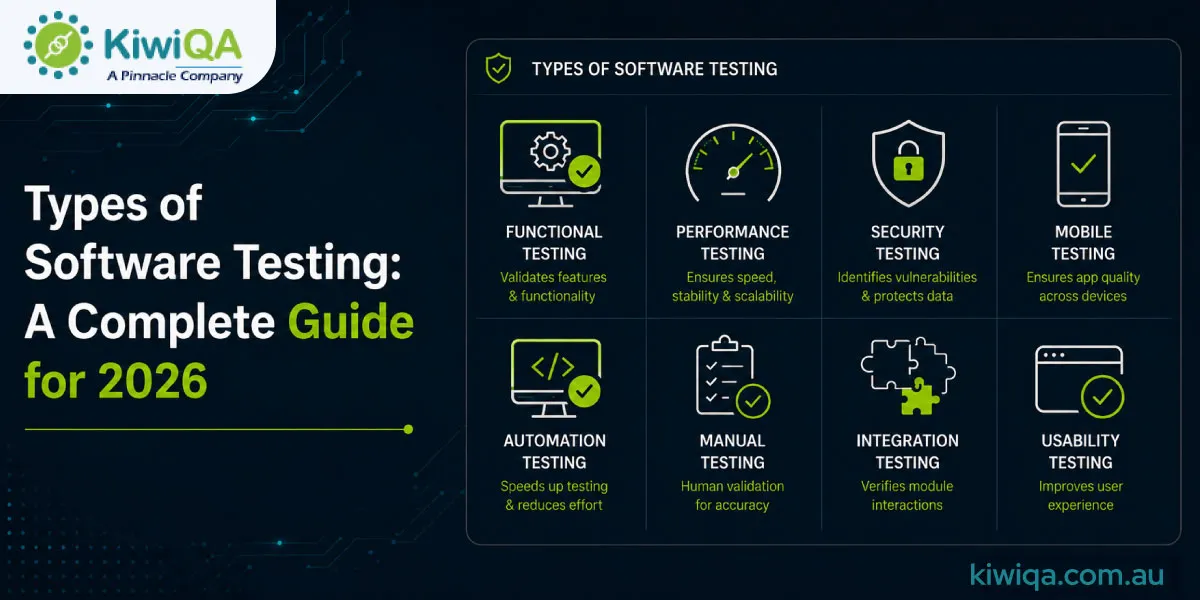
Explore the different types of software testing, including functional, performance, security and automation testing, to build reliable software in 2026.
Read More
Discover a practical software testing checklist to minimise bugs, improve application performance, and ensure successful software releases.
Read More
Fill out and submit the form below, we will get back to you with a plan.
 CRN:
22318-Q15-001
CRN:
22318-Q15-001 CRN:22318-ISN-001
 CRN:22318-IST-001
 ISOQAR-UKAS


